- Free Consultation: (813) 933-6807 Tap Here To Call Us


Extreme Speed, Street Racing, and Civil Liability: Landmark Lessons from the $176M Grossman and Erickson Verdict


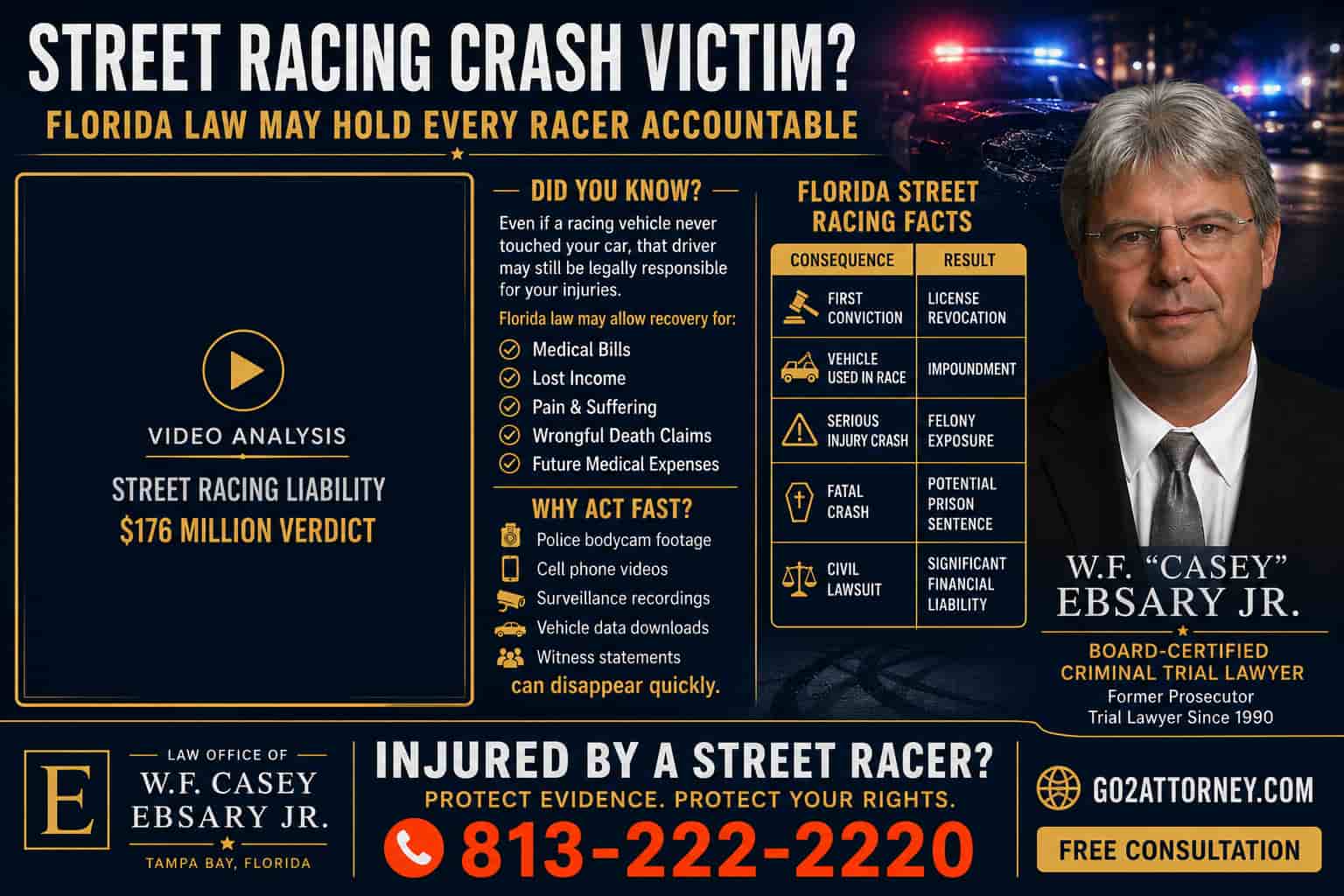
The line between a traffic infraction and a catastrophic life-altering event is remarkably thin. When drivers choose to treat public roads as personal racetracks, they are not just breaking the rules of the road—they are stepping into a legal minefield that can lead to decades in state prison and total financial ruin. As a Board-Certified Criminal Trial Lawyer with decades of experience handling severe traffic offenses, vehicular manslaughters, and high-stakes injury claims across Florida, I have watched the legal system dismantle the lives of individuals who believed a split-second decision behind the wheel would have no lasting consequences.
The Scale of Mandatory Criminal Penalties: Arming Victims with the Facts
When we represent individuals and families shattered by street racing crashes, we use Florida’s strict statutory framework to ensure reckless drivers are held accountable. The criminal penalties for violating Florida’s racing statutes escalate aggressively based on the driver’s prior record. Understanding these penalties helps us show how the state punishes these drivers, which provides a strong foundation for our civil personal injury or wrongful death claims.
A conviction under these laws means the driver faces immediate jail time and mandatory license revocation. This prevents them from hiding behind a clean driving record. Furthermore, a conviction under this statute permanently impacts their driving history, which often causes insurance companies to drop their coverage entirely or raise their premiums to unsustainable levels. This makes it crucial for us to step in immediately to secure insurance assets before they disappear.
Detailed Questions and Answers Regarding Street Racing and Victim Rights

Yes, Florida law recognizes that street races and coordinated street takeovers are fueled by crowds, so the statutes target onlookers as well. Section 316.191(2)(b) of the Florida Statutes via Justia establishes that it is illegal to knowingly act as a spectator, participate in, coordinate, or collect money at an unapproved speed contest. Spectators can be issued heavy non-criminal traffic fines and license points, while individuals who actively facilitate, record, or organize the race using social media can face full first-degree criminal misdemeanors. For victims, this means there may be multiple individuals whose reckless coordination of the event exposes them to legal responsibility.
Standard automobile insurance policies across the United States almost universally contain explicit exclusion clauses for racing, speed contests, and intentional criminal acts. If a defensive insurance carrier establishes that their policyholder was actively racing, they will routinely deny coverage for the racer’s vehicle, but this is exactly why our legal team steps in to fight for the victims. We look for alternative avenues of recovery, such as un-excluded liability coverage tiers, uninsured/underinsured motorist (UM) policies, or the personal assets of the drivers and vehicle owners to ensure your medical bills and damages are fully compensated.
Reckless driving is a broad charge applied when a motorist operates a vehicle with a willful or wanton disregard for the safety of people or property, such as extreme weaving or tailgating. A speed contest is a highly specialized criminal charge under Section 316.191 that requires explicit proof of competition, acceleration testing, or a direct response to a speed challenge. While both are serious crimes, a racing conviction triggers an automatic, mandatory one-year driver’s license revocation on the very first offense, which provides powerful leverage when we are demonstrating the driver’s absolute disregard for public safety in a civil court.
A criminal conviction provides a massive procedural advantage to victims through a legal doctrine known as negligence per se. If the state successfully convicts a driver of criminal street racing, reckless driving, or vehicular manslaughter, the civil court can accept that conviction as conclusive proof that the driver breached their legal duty of care. This shifts the entire focus of our civil personal injury or wrongful death lawsuit away from proving who caused the crash, allowing us to focus entirely on maximizing the financial recovery for your medical care, lost wages, and suffering.
Yes, passengers who choose to participate in an illegal speed contest are not insulated from the consequences of the crash. Florida law permits law enforcement to arrest and charge a passenger with a first-degree misdemeanor under Section 316.191 if they knowingly rode along in a racing vehicle or actively aided, abetted, or incited the race. In a civil injury claim, we can argue that a passenger who recorded the speed, navigated, or cheered the driver on entered into a joint venture of reckless conduct, making them jointly liable for the resulting harm.
Under standard Florida criminal procedure, law enforcement officers generally cannot make a misdemeanor arrest unless the crime occurred directly in their path, but the legislature created a powerful exception for street racing. Section 901.15(9)(d) of the Florida Statutes grants officers the explicit authority to arrest a driver without a warrant based on probable cause derived from physical evidence, dashcams, or witness statements at the scene. This rapid arrest protocol often results in the immediate seizure of cell phones, black box data, and cruiser video footage that we sub-poena to build your civil claim.
When an officer determines that a vehicle was used in an illegal race or street takeover, the state has the statutory right to order its immediate physical impoundment. Under Section 316.191(5)(c), the vehicle can be seized and locked away for 30 business days, and if the driver is a repeat offender within a five-year window, the state can initiate full forfeiture proceedings under the Florida Contraband Forfeiture Act. Our legal team moves rapidly during this impoundment window to send specialized preservation-of-evidence letters to the impound lot and the police department to ensure the vehicle is not altered before our accident reconstruction experts can inspect it.
While a convicted racer can technically apply for a hardship or business-purposes-only license under Section 322.271, the process enforces massive hurdles designed to keep dangerous drivers off the road. The driver must petition a strict administrative hearing officer, pay steep reinstatement fees, and complete intensive regular traffic safety schools before they are even considered. Hearing officers have total discretion to deny these requests, meaning these reckless individuals are frequently stripped of their legal right to drive, preventing them from endangering other families while your civil lawsuit moves forward.
You should completely decline to provide any recorded statements, sign any medical authorization forms, or accept an early settlement offer, as insurance adjusters are trained to minimize payouts by twisting your words. They often try to imply that you could have avoided the speeding vehicle or that your injuries were pre-existing. Your only response should be to inform them that you are retaining legal counsel, and then pass their contact details directly to our office so we can handle all communications and protect the true value of your claim.
Yes, you can absolutely pursue a full civil lawsuit against a driver whose vehicle never made physical contact with your car. As established by major judicial precedents like the recent $176 million Grossman and Erickson verdict, participating in a speed contest constitutes a “concert of action.” Because the non-striking driver actively incited, pressured, and participated in creating the high-speed hazard that caused the collision, the law treats them as a joint cause of the crash, meaning we can hold them fully liable for your damages.
Strategy and Preservation: Protecting Your Right to Compensation
If you or a loved one are trying to pick up the pieces after a catastrophic street racing crash or vehicle takeover in the Tampa Bay area, you must act decisively to protect your legal standing. While the state attorney prosecutes the drivers to secure jail time, our mission at the Law Office of W.F. “Casey” Ebsary Jr. is to protect your family’s financial future by securing full compensation for your medical treatments, rehabilitation, and long-term losses.
We utilize our extensive backgrounds in both criminal trial mechanics and civil tort law to aggressively investigate the scene, uncover hidden insurance policies, and counter the tactics used by defense firms. We know how the state builds its criminal files, and we use that insider knowledge to construct a rock-solid foundation for your civil personal injury claim.
Your Immediate Evidentiary Protocol
- Secure Electronic Logs: Preserve any dashcam footage, digital photographs of your injuries, cell phone records, or GPS navigation logs from the day of the crash without modifying the files.
- Identify Local Surveillance: Look for nearby business security cameras, residential smart doorbells, or municipal traffic cameras that may have captured the vehicles racing before the impact occurred.
- Document Every Loss: Maintain an absolute log of all medical visits, physical therapy sessions, out-of-pocket prescription expenses, and calendar days missed from work due to your recovery.
The staggering $176 million civil jury verdict handed down in California against Los Angeles socialite Rebecca Grossman and former Major League Baseball pitcher Scott Erickson represents a watershed moment in American traffic law. It highlights a critical, often misunderstood legal reality: you do not have to physically strike a victim to be held fully liable for their death if you participated in a speed contest.
If you are currently facing high-speed traffic charges, or if you are dealing with the aftermath of a catastrophic accident, you must understand how the courts treat street racing, reckless driving, and joint liability. My goal is to outline the mechanics of these high-stakes cases and show you how we approach complex traffic defense and civil exposure from our offices in Tampa.
The Westlake Village Crash and the Anatomy of a $176,000,000 Verdict
To understand how the legal system extracts such monumental penalties, we have to look directly at the evidence that swayed both a criminal and a civil jury in the 2020 Westlake Village tragedy. On September 29, 2020, Nancy Iskander and her children were crossing a marked residential crosswalk on Triunfo Canyon Road. At that exact moment, Rebecca Grossman and Scott Erickson were operating separate Mercedes SUVs along the same roadway.
The evidence across both trials revealed that the two drivers had consumed alcohol at a local establishment prior to the crash and were engaged in an impromptu, high-speed speed contest, reaching speeds of roughly 80 miles per hour in a 45 mile-per-hour residential zone. While Erickson’s vehicle narrowly cleared the crosswalk, Grossman’s vehicle struck and killed 11-year-old Mark and 8-year-old Jacob Iskander. Grossman then fled the immediate scene, stopping only when her vehicle’s engine automatically disabled one-third of a mile away due to airbag deployment.
The Staggering Legal Outcomes
The dual tracks of the American justice system—criminal prosecution and civil litigation—responded with absolute severity. The details of the outcomes for both drivers demonstrate how a single event creates distinct legal exposures.
| Defendant | Criminal Trial Resolution | Civil Jury Liability Verdict | Compensatory Damages Awarded |
| Rebecca Grossman | Convicted of two felony counts of 2nd-Degree Murder, two counts of Vehicular Manslaughter with Gross Negligence, and one count of Hit-and-Run. Sentenced to 15 years to life in state prison. | Found negligent and determined by clear and convincing evidence to have acted with conscious malice. | $176,000,000 (Subject to joint and several liability frameworks) |
| Scott Erickson | Avoided criminal incarceration by entering into a court-approved agreement to film a public safety announcement on safe driving. | Found negligent; determined to have acted with conscious malice and to be a substantial factor in the deaths. | $176,000,000 (Subject to joint and several liability frameworks) |
This case acts as a clear warning. Even though Scott Erickson did not physically hit the children with his SUV, the civil jury found him completely liable for the $176 million compensatory award alongside Grossman. Furthermore, the jury’s finding of “malice” means the case enters a punitive damages phase, which can increase the final financial judgment exponentially.
How the Law Holds the Non-Striking Driver Responsible
The question I hear most frequently from clients confronting street racing or reckless driving allegations is: “How can I be blamed if my car never touched anyone?”
The answer lies within a long-established legal framework known as the Concert of Action doctrine. In civil tort law, when two or more individuals cooperate in an illegal or highly dangerous activity, every single participant is legally deemed to be the agent of the other. By engaging in a high-speed race, each driver actively incites, encourages, and pressures the other to push their vehicle to dangerous limits.
When Scott Erickson chose to accelerate his vehicle alongside Rebecca Grossman, his actions directly contributed to the high-velocity environment that made it impossible for Grossman to stop when she approached the pedestrian crosswalk. The law views this as a chain of proximate causation. If you help light the fuse of a dangerous situation, you cannot escape liability simply because the explosion occurred a few feet behind your bumper.
Street Racing and Extreme Speed Under Florida Law
While the Grossman case occurred in California, my practice focuses intensely on how these exact behaviors are prosecuted under Florida’s incredibly strict motor vehicle statutes. If you are pulled over or arrested for racing in the Sunshine State, you are not facing a simple traffic ticket—you are facing a criminal misdemeanor or felony charge that carries mandatory administrative penalties.
Illegal street racing, street takeovers, and stunt driving are strictly governed by Section 316.191 of the Florida Statutes via Justia. The state legislature has continually revised this statute to give law enforcement broader authority to make warrantless arrests and seize property on the spot.
The Definition of Racing Under the Statute
Under Florida law, a “race” does not require an organized track, formal timing gear, or a pre-arranged route. The statute explicitly covers any competition arising from a challenge to demonstrate the superiority of a vehicle or driver, and the acceptance or competitive response to that challenge. This means if you pull up next to a vehicle at a red light on Dale Mabry Highway or Gandy Boulevard, lock eyes with the other driver, and rapidly accelerate to outdistance them when the light turns green, you have committed the criminal offense of racing.
To learn more about our decades of trial experience, our board-certified legal credentials, and how we advocate for injured families across Hillsborough County, you can view our background at Our Firm’s Trial Background and Professional Credentials. When you are ready to hold the reckless drivers accountable and explore your pathways to recovery, reach out directly through our Secure Victim Consultation Portal.
Verification and Statutory Accuracy Disclaimer
Note on Statutory Frameworks: All references to Florida Statutes, including Section 316.191 (Racing on Highways), Section 901.15 (Warrantless Arrest Exceptions), and Section 322.271 (Hardship Reinstatement), are verified accurate as of June 2026. The case mechanics discussed regarding joint tortfeasor liability and concert of action doctrines represent established personal injury law principles in the State of Florida. Because every traffic collision involves unique factors, insurance policy exclusions, and specific evidence, this material is for informational and advocacy outreach purposes and does not constitute formal legal advice until a formal representation agreement is executed.