- Free Consultation: (813) 933-6807 Tap Here To Call Us


Florida Dram Shop Lawyer: Can You Sue a Bar for a Drunk Driving Accident Under 768.125?


Victims Version: Liability for Injuries From Bars Over Serving
Florida Dram Shop Law for Victims: Can You Sue a Bar After a Drunk Driving Crash?
What is a Florida Dram Shop Lawyer? When someone is hurt because a bar kept serving alcohol to a person who was clearly a danger, the pain is not just physical — it is emotional and financial too. Medical bills pile up. Work is missed. Families are left asking how this could have happened.
I am W.F. Casey Ebsary, Jr., a Florida Dram Shop Lawyer and I want to explain your rights in plain English. If you were injured by someone who had been drinking at a bar or restaurant, you may be wondering whether that business can be held responsible. The answer in Florida is: sometimes — but the law is strict.
What Is a “Dram Shop” Case?
The term “dram” originates from 18th-century England, where a dram was a small unit of liquid measurement used to serve spirits. Taverns that sold liquor by the dram became known as “dram shops.” Over time, American courts adopted the phrase to describe laws regulating alcohol vendors’ civil responsibility.
A Dram Shop case is simply a lawsuit against a bar, restaurant, or other business that served alcohol to someone who later caused harm. These cases usually involve drunk driving crashes, but they can also involve assaults or other serious injuries.
The idea behind these cases is fairness. If a business makes money selling alcohol, it must follow the law when serving it. When a business breaks that law and someone gets hurt, the law may allow a Florida Dram Shop Lawyer to file a claim.
Is It Easy to Sue a Bar in Florida?
No. Florida law makes these cases more difficult than in many other states. A bar is not automatically responsible just because someone drank there and then caused a crash.
Under Florida law, there are only two situations where a bar can usually be held responsible:
- The bar knowingly served alcohol to someone under 21.
- The bar knowingly served someone who has a long history of alcohol addiction.
If neither of those situations applies, the bar is usually protected from liability.
That does not mean you do not have a case. It means a Florida Dram Shop Lawyer must carefully investigate the facts.
What If the Driver Was an Adult?
If the driver was over 21, the key question becomes whether the bar knew the person had a serious, ongoing alcohol problem. This is not about whether the person looked drunk that night. It is about whether the business knew the person struggled with alcohol addiction and kept serving them anyway.
To prove this, I look at patterns. Did the person frequently drink there? Did staff know them well? Were there prior problems? Did the person openly talk about their drinking issues? These details matter.
What About the Drunk Driver?
Even if a claim against the bar is difficult, the driver who caused the crash can still be held responsible. In most cases, we pursue the driver first through their insurance coverage.
But sometimes insurance limits are not enough to cover the full cost of serious injuries. That is when we examine whether a claim against the bar is possible.
Why Evidence Matters So Much
In these cases, timing is critical. Many bars automatically erase surveillance video within days. Receipts and transaction records can disappear. Witnesses forget details.
One of the first things I do is send written notice demanding that evidence be preserved. That includes:
- Video footage
- Sales receipts
- Staff schedules
- Incident reports
If evidence is destroyed after notice, that can help your case.
How Do We Show the Person Was Intoxicated?
We look at everything available. Police reports often describe slurred speech, unsteady walking, or other signs of impairment. Breath or blood test results can show alcohol levels. Witnesses may describe behavior inside the bar.
Alcohol affects people differently. Some long-time drinkers may not appear obviously drunk even with high alcohol levels. That is why we sometimes work with experts who can explain how alcohol impacts judgment, reaction time, and decision-making.
But the goal is simple: to show what happened and whether it could have been prevented.
How Does Florida’s Insurance System Affect My Case?
Florida requires drivers to carry personal injury protection (PIP) insurance. That coverage helps pay initial medical bills, regardless of who caused the crash. However, it is limited.
If your injuries are serious or permanent, you may step outside that system and pursue full compensation from the at-fault driver — and possibly the bar if the law allows.
There is also a strict deadline. In most injury cases in Florida, a lawsuit must be filed within two years of the accident. Waiting too long can permanently block your claim.
What Damages Can I Recover?
If successful, a claim may include compensation for:
- Medical expenses
- Lost income
- Future medical care
- Pain and suffering
- Permanent injury
Every case is different. The value depends on the severity of injuries and available insurance coverage.
Is Every Drunk Driving Crash a Case Against the Bar?
No. And I will be honest with you about that. Florida law protects bars in many situations. But when a business breaks the rules and someone gets hurt, accountability matters.
My job is to investigate thoroughly and tell you the truth about your options.
What Should I Do If This Happened to Me?
First, focus on your health. Seek medical treatment right away and follow your doctor’s advice. Keep copies of all medical records and bills.
Second, do not speak with insurance adjusters alone about settlement offers before understanding your rights. Early offers are often far less than what a serious injury truly costs.
Third, speak with a lawyer who understands both the legal and practical challenges of these cases.
How I Approach These Cases
When I take a case involving alcohol-related injuries, I act quickly. I gather evidence. I consult experts when necessary. I examine whether the law allows a claim against the bar. And I prepare the case as if it may go to trial.
I believe injured people deserve straight answers and strong representation.
Speak With Me Directly
If you or a loved one were injured by someone who was overserved at a bar, you deserve clarity about your rights.
You can learn more about me here:
https://www.go2attorney.com/lawyers/w-f-casey-ebsary-jr/
If you are ready to talk about your case, contact me here:
https://www.go2attorney.com/contact-us/
I am W.F. Casey Ebsary, Jr., and I am committed to helping injury victims understand their options and pursue fair compensation when the law allows it.
Florida Dram Shop Lawyer’s Version
As an attorney practicing in Florida, I, W.F. Casey Ebsary, Jr., have seen how devastating an injury caused by an intoxicated person can be. Your immediate need is for honest, factual answers about your legal rights. This is why I have prepared this comprehensive guide, blending my experience with the critical scientific and legal analysis that underpins successful Dram Shop and serious injury cases in our state. For my clients, the question is not just who was at fault, but what evidence and which experts we need to prove it.
A “dram shop” refers to a business that sells alcoholic beverages, such as a bar, tavern, or restaurant. In modern legal terms, “dram shop liability” describes statutes that allow injured parties to sue an alcohol vendor for harm caused by an intoxicated patron under certain circumstances. In Florida, that liability is governed by Florida Statute 768.125, which creates limited exceptions to vendor immunity.
The term “dram” originates from 18th-century England, where a dram was a small unit of liquid measurement used to serve spirits. Taverns that sold liquor by the dram became known as “dram shops.” Over time, American courts adopted the phrase to describe laws regulating alcohol vendors’ civil responsibility.
Part I: Florida Dram Shop Liability—The Strict Standard
When an alcohol vendor overserves a person who then causes harm, a civil claim against the vendor is known as a Dram Shop action. I want you to understand that Florida’s law is one of the most restrictive in the nation, making these cases challenging, but absolutely winnable with the right evidence. My firm is prepared to meet the high burden of proof these cases demand.

Florida Statute 768.125 is the law that governs when a vendor, like a bar or restaurant, can be held liable for injuries caused by an intoxicated patron. The statute generally protects alcohol vendors and sellers from liability if the person they served was of legal drinking age at the time. However, the law provides two very narrow exceptions to this general immunity, and it is on these exceptions that we must build your case. Because the state’s law preempts common-law negligence in this area, we must strictly adhere to the statute’s requirements.
I can pursue a claim for you under Florida’s Dram Shop Act if the vendor willfully and unlawfully sold or furnished alcohol to either of two groups: a person under the age of 21, or a person who is habitually addicted to the use of any or all alcoholic beverages. If my injury was caused by an intoxicated person who was of legal drinking age and not habitually addicted, the vendor is typically shielded from liability. We must gather evidence to prove the vendor’s knowledge of the person’s status as a minor or a known alcoholic to successfully navigate this exception.
Proving a patron was “habitually addicted” is a significant legal challenge that I take on by gathering extensive evidence that shows the vendor had actual knowledge of the addiction. This is not simply about the patron being visibly drunk on the night of the accident; we must prove they had a long-standing drinking problem and that the vendor’s staff was aware of it. We use evidence like repeated visits, documented intoxication issues, staff testimony, and surveillance footage to establish this critical element and overcome the vendor’s statutory immunity.
The full text of the law is a must-read for any case: Florida Statute § 768.125 – Justia Law and on the official state site: Florida Statute 768.125.
Part II: The Science of Proof—Toxicology and Impairment
In a Dram Shop case, the central issue is not just the act of serving but the patron’s state of intoxication. This is where my team brings in forensic toxicology experts to bridge the gap between the law and the science, providing the objective proof courts require. We rely on principles that explain exactly what alcohol does to the human body.
The toxicologist’s primary role is to provide a scientific answer to the central question in nearly every case: “Was this person visibly intoxicated when served?”. These experts help me prove the level of physiological impairment by reconstructing the patron’s probable Blood Alcohol Concentration (BAC) at the time of service, which behavioral signs that BAC would have produced, and whether alcohol tolerance was a factor in masking those signs. Without this qualified scientific expertise, plaintiffs frequently struggle to overcome a motion for summary judgment on the visible intoxication element.
Retrograde extrapolation is a critical scientific tool I use that involves working backward from a known post-incident BAC test result to estimate what the person’s BAC was at an earlier relevant time, such as when they were last served at the bar. The toxicologist applies a scientifically supported elimination rate, which averages around 0.018% per hour, but this process is highly individualized. The expert needs to account for factors like the person’s weight, sex, drinking history, and food consumption to reliably estimate the BAC at the time of service or driving.
Tolerance is the phenomenon where a person experiences a reduced effect from a drug after prolonged exposure, and it is a key factor in defending or proving a Dram Shop case. Functional Tolerance means a person exhibits reduced signs of visible intoxication despite having a high BAC due to the brain’s adaptation to alcohol. My experts use analysis of a patron’s prior alcohol use or chronic liver disease, which is relevant and admissible, to explain why bar staff may have seen few signs despite significant alcohol consumption.
Yes, the recognized stages of acute alcohol intoxication, while based on social drinkers, provide a useful framework for my expert to translate a calculated BAC into expected observable signs. For example, a BAC in the Euphoria range (0.03-0.12% BAC) is expected to produce diminished judgment and decreased inhibitions. If the person was in the Excitement stage (0.09-0.25% BAC), the expected signs are impaired memory, slurred speech, and loss of critical judgment, which would be visible to bar staff.
Part III: The Florida Dram Shop Lawyer Litigation Battlefield—Evidence and the Daubert Standard
Winning a complex personal injury case, especially one involving the specific exemptions of the Dram Shop Act, depends on the admissibility and credibility of our expert testimony. In Florida, this means our toxicologist must meet the rigorous Daubert standard. My job is to ensure our experts are qualified and their methodology is scientifically sound.
The Daubert Standard is a three-part test that courts in Florida apply to all expert witnesses to act as a gatekeeper of evidence. I must demonstrate by a preponderance of the evidence that my toxicologist is Qualified to testify, that their methodology (like retrograde extrapolation) is Reliable and scientifically sound, and that their testimony will be Helpful to the jury on a disputed issue. Failure to meet even one of these elements can lead to the expert being excluded from testifying, as we saw in the Florida case State v. Williams, where a DUI deputy was excluded for lacking a scientific understanding of the formula they applied.
My toxicologists perform four key roles to ensure our evidence is robust:
BAC Reconstruction: Calculating the patron’s probable BAC at each service point, requiring data like drinks served, timing, weight, and drinking history.
Retrograde Extrapolation: Working backward from a post-incident BAC test to estimate the BAC at the time of driving or service.
Behavioral/Clinical Correlation: Translating the calculated BAC into the expected observable signs, such as slurred speech, unsteadiness, or impaired judgment.
Alcohol Tolerance Analysis: Analyzing prior alcohol use to explain why a patron may have exhibited few visible signs despite a significantly elevated BAC.
Courts are very precise about what type of expert can testify on which issue to ensure the testimony is helpful and not just general knowledge. A toxicologist is generally permitted when the BAC and its physiological effects are directly disputed, as their testimony is unique and unreplaceable. However, an expert on Dram Shop compliance or regulation may be excluded if their opinion relies solely on documents that the jury can read directly, adding nothing beyond what the fact-finder already has.
Part IV: The Florida Dram Shop Lawyer Framework—Statutes and Deadlines
While the Dram Shop and toxicology are crucial components, my team and I must also navigate the fundamental procedural and statutory requirements of Florida’s overall personal injury and auto accident laws. We must act quickly, as strict deadlines apply.
As your attorney, I must first navigate Florida’s No-Fault system, which is centered around Personal Injury Protection (PIP) insurance. This PIP coverage, which every Florida driver must carry, pays a minimum of $10,000 for my initial medical bills and lost wages, regardless of who caused the crash. As of 2025, Crucially, I must seek initial medical treatment within 14 days of the accident to be eligible for these PIP benefits.
I can only step outside the No-Fault system and sue the at-fault driver—and potentially the Dram Shop vendor—for non-economic damages, like my pain and suffering, if my injuries meet the state’s “serious injury threshold”. I will work with your treating physicians and my experts to prove that your injury is a permanent injury, significant and permanent scarring or disfigurement, permanent loss of an important bodily function, or death.
As of 2025, for most negligence-based personal injury claims in Florida, the statute of limitations is now two years from the date the injury occurred. This deadline is absolute, and a failure to file a lawsuit within that two-year period means I will lose the right to pursue compensation entirely. Because of the time required to conduct a thorough investigation, including obtaining toxicology reports and securing surveillance footage, I strongly urge you to contact me immediately.
Florida Statute 95.11 (2025) governs the statute of limitations.
Visualizing Your Florida Dram Shop Lawyer Case: Liability and Evidence
My firm uses tables and visual aids to simplify complex legal standards for my clients, for insurance adjusters, and for the court.
Table: Dram Shop Liability Standards (Focus on Florida)
| Issue | Texas | Ohio | Florida | Florida Proof Required |
|---|---|---|---|---|
| Key Standard | “Obviously intoxicated” | Actual knowledge required | Limited Exceptions | Proof the vendor willfully and unlawfully served a minor OR a habitually addicted person |
| Exclusive Remedy | Yes | Yes | Yes | Florida Statute § 768.125 preempts common law negligence against sellers |
| BAC Proof | Requires visible signs at service | Requires actual knowledge | Forensic Toxicology | BAC Reconstruction, Retrograde Extrapolation, and Tolerance Analysis are essential |
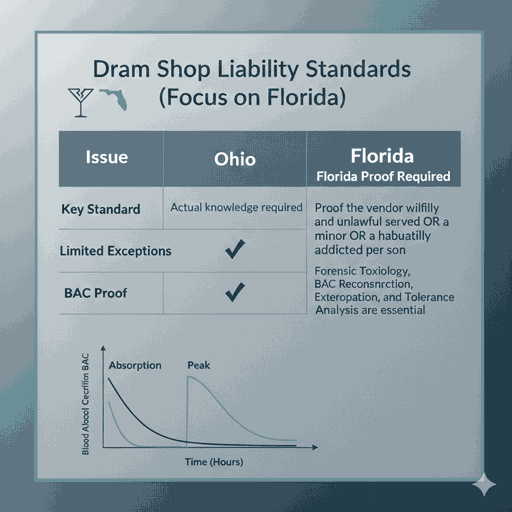
A chart visually illustrating the three phases of alcohol toxicokinetics (Absorption, Peak, Elimination) and the concept of Retrograde Extrapolation.
Final Florida Dram Shop Lawyer Q&A and How I Can Help You
I believe that the best defense is a great offense built on fact, science, and rigorous legal preparation. As your attorney, I will handle the complexity of the Dram Shop Statute, hire the necessary toxicology and medical experts, and manage the entire litigation process so that you can focus solely on your recovery.
This is one of the most difficult challenges, but I overcome it by building a strong circumstantial case based on patterns of conduct, not just one evening. I would investigate the patron’s history of frequenting the company establishment, any statements made to staff, and the staff’s general knowledge about the patron’s drinking habits. We also look for evidence of prior DUIs, alcoholism diagnosis, or treatment records, all of which lend credibility to the knowledge requirement.
While all evidence is important, the most crucial evidence is the documentation that either proves the patron was a minor, or that the vendor knew the patron was habitually addicted. Beyond that, for any intoxication case, having qualified expert testimony that is permitted under the Daubert Standard—specifically the toxicologist’s testimony on the patron’s physiological state at the time of service—is what often makes or breaks my client’s ability to defeat summary judgment.
The very first action we take is to issue preservation letters to all potential defendants, including the vendor, to legally require them to preserve critical evidence like surveillance video and bar receipts. We do this to prevent spoliation of evidence, which can create a favorable inference for my client on the issue of intoxication. Simultaneously, we will secure police, medical, and toxicology reports to begin our BAC reconstruction and expert analy
I a Florida Dram Shop Lawyer and am ready to review your case and start fighting for your financial recovery.
I am W.F. Casey Ebsary, Jr., and I am committed to fighting for the justice you deserve. We can immediately begin the crucial investigation into the Dram Shop vendor’s liability.
To learn more about my background and experience, please visit my Bio Page.
To schedule a free consultation with me, W.F. Casey Ebsary, Jr., please visit our Contact Page.