- Free Consultation: (813) 933-6807 Tap Here To Call Us


High Speed Crash Injuries?



Video Analysis: What the Police Footage Can Mean in a High Speed Crash Injury Case
Publicly released footage reported by the Associated Press shows law enforcement responding to a high-speed collision in Connecticut involving Vince McMahon. According to the officer’s on-scene statements captured on video, speeds were reported to have exceeded 100 mph prior to impact. In a personal injury case, recorded video can become significant evidence in a high speed crash.
No Civil Lawsuit Filed as of March 2026
The lack of a lawsuit following Vince McMahon’s 115 MPH crash is a textbook example of how high-stakes insurance and “goodwill” defense strategies work. As a Board-Certified Trial Lawyer, I look at these cases through the lens of liability and leverage.
Here are the primary reasons no civil lawsuit was filed:
1. No Physical Injuries Reported
In both Florida and Connecticut, a personal injury lawsuit requires a “threshold” of permanent or significant injury.
- The Reality: Despite his Bentley and the victim’s BMW being totaled, the driver, Barbara Doran, and her dog were reportedly “fine” and “unscathed,” aside from a stiff neck.
- Legal Barrier: Without a permanent injury (like a fracture or surgery), a lawsuit for “pain and suffering” is incredibly difficult to sustain. If there are no medical damages, there is no case for a lawyer to take.
2. Immediate “Goodwill” and Apology Notes
McMahon’s legal team, led by Mark Sherman, took a proactive approach that I often recommend.
- The Outreach: McMahon reportedly sent two apology notes to the other drivers through his counsel.
- The Result: This human connection often de-escalates a victim’s desire to sue. When a defendant is seen as “appreciative” and concerned rather than combative, victims are less likely to seek “punitive” justice through the courts.
3. Full Insurance Coverage
McMahon was confirmed to be fully insured.
- Quick Settlements: When a wealthy defendant is clearly at fault and has high policy limits, insurance companies usually pay the property damage claims (the cost of the totaled BMW) immediately.
- No Need for a Suit: If the insurance company pays for the car and the medical check-up, and the victim is made whole, there is no remaining “dispute” for a judge to settle.
4. No Opposition to Diversion
Perhaps most telling is that none of the other drivers objected to McMahon entering the Accelerated Pretrial Rehabilitation program. In my experience at go2attorney.com, this almost always indicates that a private settlement for property damage and minor inconveniences was reached before the court date.
The Key Takeaway
In the world of High-Speed Crash Defense, silence is often a sign of a very successful legal strategy. By handling the property damage quickly and maintaining a respectful tone, McMahon avoided a “Super Speeder” civil nightmare.
When I analyze video in a civil case, I am not looking for headlines — I am looking for proof. Body camera footage can help establish timeline, roadway conditions, driver demeanor, and immediate statements. It can also document whether emergency lights were activated, how traffic was flowing, and how the impact scene appeared moments after the crash.
High Speed Crash Video for Context
For informational purposes, media outlets such as the Associated Press have reported on and published segments of the Connecticut crash footage. If you are reviewing similar coverage, remember that media clips are summaries. In a civil lawsuit, we seek the complete, unedited recordings to ensure full context.
Why Video Matters in a High Speed Crash Negligence Lawsuit
In a Florida personal injury claim, we must prove that the at-fault driver breached a duty of reasonable care and that the breach caused injury. Video footage can support or contradict written crash reports. Jurors often place substantial weight on what they can see and hear directly rather than relying solely on testimony.
For example, if an officer states on camera that the vehicle was traveling in excess of 100 mph, that statement may become part of the evidentiary record. If the driver makes spontaneous statements about speed or circumstances, those statements can also be admissible depending on evidentiary rules. In my experience, early recorded statements frequently shape how insurance carriers evaluate exposure.
What I Look for When Reviewing Crash Video
When I review footage in a high-speed injury case, I carefully analyze:
- The officer’s description of speed and positioning
- Statements made by the driver
- Traffic density and roadway visibility
- The condition of the vehicles
- Any discussion of distraction, impairment, or medical issues
Video often clarifies whether the crash appears consistent with excessive speed. It may also confirm whether the injured party’s vehicle was lawfully positioned and traveling normally at the time of impact.
How Video Impacts Settlement Negotiations
Insurance companies evaluate cases based on trial risk. If a jury would likely see clear video evidence of extreme speed or dangerous driving behavior, the settlement value of the case may increase. Conversely, if the footage introduces ambiguity, insurers may contest liability more aggressively.
In high-speed crashes, visual evidence can shift negotiations from debate to documentation. That is why I always request and preserve body camera, dash camera, and surveillance footage as early as possible in a serious injury claim.
If you were injured in a high-speed crash and video evidence exists, I strongly recommend acting quickly to preserve it. Video can be overwritten or lost if not formally requested. If you would like me to evaluate your case, you can contact me here:
https://www.go2attorney.com/contact-us/
Or learn more about my background and experience here:
https://www.go2attorney.com/lawyers/w-f-casey-ebsary-jr/
In serious injury cases, evidence matters — and video often becomes one of the most important pieces.
Police video shows Vince McMahon’s 100 mph car crash in Connecticut
Injured in a 100+ MPH Crash? What I Want You to Know About Your Civil Injury Claim

When I review police body camera footage from high-speed crashes, one thing is always clear: physics does not negotiate. Recently, publicly released video covered by the Associated Press showed a crash in Connecticut involving former wrestling executive Vince McMahon, where officers reported speeds exceeding 100 mph prior to impact.
As a personal injury attorney, I look at situations like this from one perspective: if you were in the vehicle that was struck, what are your rights? If someone drives at triple-digit speeds and causes a collision, the injured person may have the right to pursue full compensation under civil law. On this page, I explain how those claims work in Florida, what must be proven, and how I approach these cases for my clients.
If you would like to learn more about my background, you can visit my bio here:
https://www.go2attorney.com/lawyers/w-f-casey-ebsary-jr/
If you need immediate help, contact me directly here:
https://www.go2attorney.com/contact-us/
What Happens Legally When Someone Is Injured in a High-Speed Crash?
When a driver travels at extreme speeds and causes a crash, the injured party may file a civil lawsuit for negligence. In Florida, negligence requires proof of duty, breach, causation, and damages. Every driver owes a duty to operate their vehicle safely and obey traffic laws under Chapter 316 of the Florida Statutes, which you can review at the official Florida Legislature website:
https://www.leg.state.fl.us
Excessive speed is often powerful evidence of breach of duty. Under Florida law, speed regulations are found in Florida Statute 316.183, available on Justia here:
https://law.justia.com/codes/florida/title-xxiii/chapter-316/section-316-183/
If a driver exceeds safe speeds and injures another person, civil liability may follow regardless of whether criminal charges are filed.
Does Driving Over 100 MPH Automatically Make Someone Liable?
No single number automatically determines liability, but extreme speed can strongly support a negligence claim. In civil court, we do not have to prove “criminal recklessness.” We must prove that the driver failed to act reasonably under the circumstances.
When speeds reach 100 mph or more, juries tend to view that conduct as inherently dangerous. Even without alcohol or distraction, excessive speed alone may establish breach of duty if it caused the collision.
Civil liability focuses on harm — not punishment. The central question is whether that speed caused injury.
What Must I Prove in a Florida Personal Injury Case?
Under Florida negligence law, the injured party must show:
| Element | What It Means | How It Is Proven |
| Duty | Driver owed obligation to operate safely | Established by traffic laws |
| Breach | Driver failed to act reasonably | Speed, video, crash data |
| Causation | Breach caused the injury | Expert analysis |
| Damages | Actual harm occurred | Medical records & bills |
Florida follows a modified comparative negligence system under Florida Statute 768.81, available on Justia:
https://law.justia.com/codes/florida/title-xlvi/chapter-768/section-768-81/
If an injured person is more than 50% at fault, recovery may be barred. If they are 50% or less at fault, damages are reduced proportionally.
What Types of Damages Can Be Recovered?
When I represent someone injured in a high-speed crash, we pursue all legally available damages. These may include medical expenses, future treatment costs, lost wages, diminished earning capacity, pain and suffering, and property damage.
In catastrophic cases, future medical needs can be substantial. Florida law allows recovery for future damages that are reasonably certain to occur.
Below is a simplified damages overview:
| Damage Category | Description |
| Medical Expenses | Hospital, surgery, therapy |
| Lost Wages | Missed time from work |
| Future Care | Long-term rehabilitation |
| Pain & Suffering | Physical and emotional harm |
| Property Damage | Vehicle repair or replacement |
Each case depends on documented evidence, medical expert testimony, and economic analysis.
Does Police Video Help in a Civil Case?
Yes. Video can be powerful evidence in civil litigation. Body camera footage, dash camera recordings, and crash reconstruction data often clarify what happened in the seconds before impact.
In a high-speed case, video may confirm:
- Reported speed
- Traffic conditions
- Driver statements
- Officer observations
In my experience, video often becomes central to settlement negotiations. Insurance companies evaluate risk based on what a jury would see.
What If the At-Fault Driver Claims It Was an Accident?
In civil court, nearly every defendant claims the crash was accidental. However, negligence law does not require intentional misconduct. It requires unreasonable conduct.
Driving at excessive speeds may be unreasonable even if the driver did not intend to cause harm. If the conduct created foreseeable risk and resulted in injury, liability may attach.
Intent is not required for negligence.
What If the Injured Person Was in the Vehicle That Was Hit?
If you were the driver or passenger in the struck vehicle, your claim may involve:
- Personal Injury Protection (PIP) benefits under Florida’s no-fault system
- A bodily injury claim against the at-fault driver
- Potential uninsured or underinsured motorist coverage
Florida’s no-fault insurance requirements are outlined in Florida Statute 627.736:
https://law.justia.com/codes/florida/title-xxxvii/chapter-627/section-627-736/
However, in serious injury cases involving permanent injury, Florida law allows injured victims to step outside the no-fault system and pursue full damages.
How Severe Are High-Speed Crash Injuries?
High-speed crashes frequently result in:
- Traumatic brain injury
- Spinal cord damage
- Multiple fractures
- Internal organ injury
The force of impact increases exponentially with speed. A crash at 100 mph carries significantly greater destructive force than one at 50 mph.
Below is a conceptual injury severity comparison:
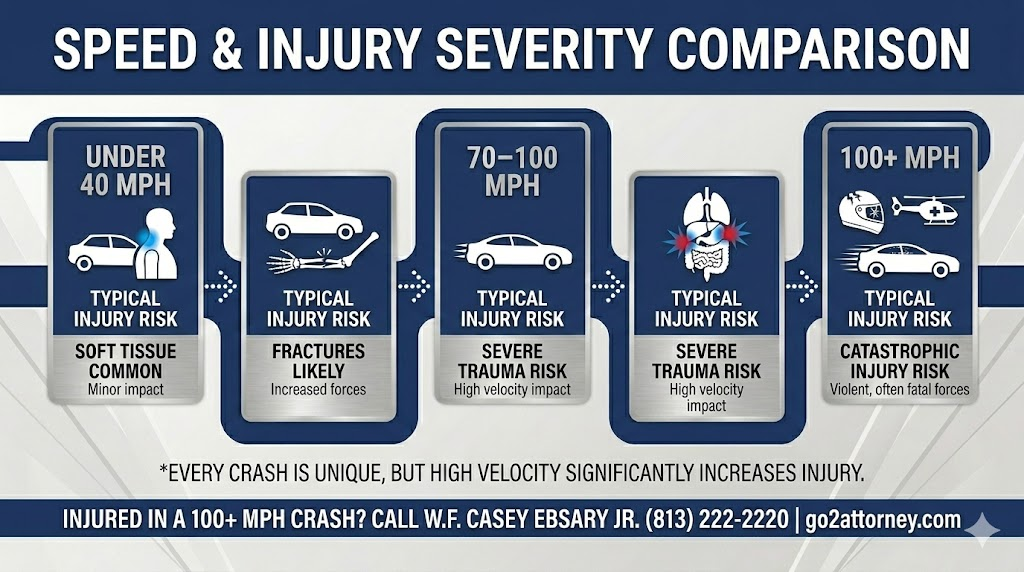
Every crash is unique, but high velocity significantly increases injury probability.
“As a Board-Certified Expert, I know that physics don’t lie. When I take on a case, I’m not just looking at medical bills; I’m analyzing the extreme forces involved. Every crash is unique, but as this Speed Severity infographic shows, high velocity exponentially increases the risk of catastrophic injury. We use forensic accident reconstruction, charts, and expert analysis—the same tools I used as a prosecutor—to break down these cases. If you’ve been injured because someone else was reckless at 100+ MPH, I have the experience to demand the maximum compensation you deserve. Contact me directly through my contact page or call (813) 222-2220. I am available 24/7/365 to start fighting for your recovery.”
In Florida, punitive damages are governed by Florida Statute 768.72:
Punitive damages require clear and convincing evidence of intentional misconduct or gross negligence. While not automatic, extreme speed combined with aggravating factors may justify a request for punitive damages in certain cases. Punitive damages are designed to punish and deter, not merely compensate.
High Speed Crash Evidence Collection
When someone contacts me after a severe crash, I examine:
- Crash report and citations
- Video evidence
- Black box or event data recorder data
- Medical documentation
- Insurance coverage limits
We then build a liability model that estimates exposure based on injury severity and comparative fault.
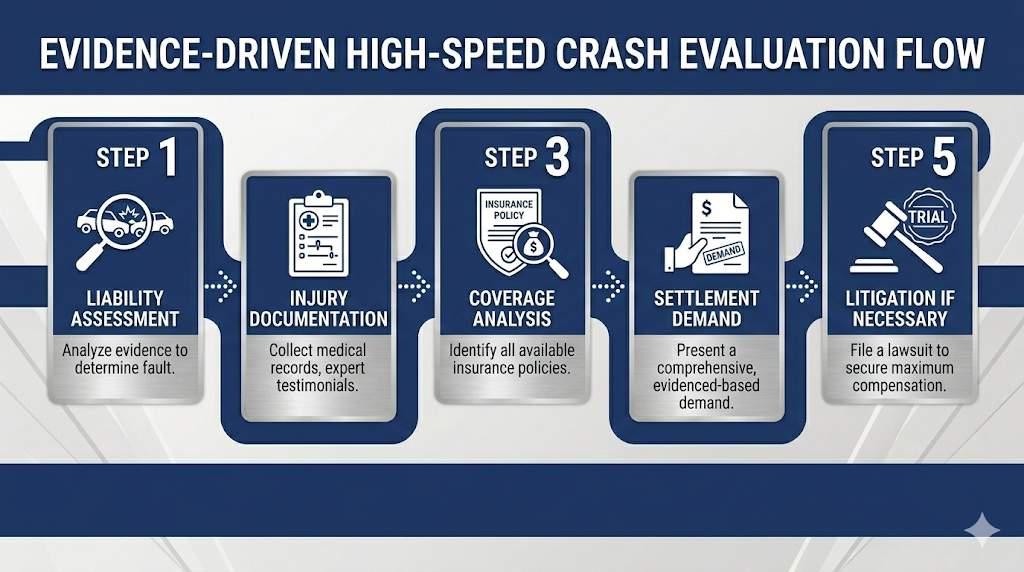
My approach is evidence-driven and grounded in statutory law.
Frequently Asked Questions

Yes. Civil liability is separate from criminal prosecution. Even if no criminal charges are filed, a civil negligence claim may still succeed if the evidence proves unreasonable conduct caused your injury.
We rely on objective evidence such as crash reconstruction, vehicle data recorders, and officer observations. Video footage and physical damage patterns can support speed estimates.
Florida’s statute of limitations for negligence actions is found in Florida Statute 95.11. You can review it here:
https://law.justia.com/codes/florida/title-viii/chapter-95/section-95-11/ Time limits vary based on the type of claim, so prompt legal evaluation is critical.
Insurance companies evaluate risk strategically. Before accepting any offer, I recommend reviewing the full scope of your injuries and future damages with counsel.
Under Florida’s comparative negligence system, your recovery may be reduced by your percentage of fault, provided it does not exceed 50%.
Why I Handle High-Speed Injury Cases Personally
When I review cases involving extreme speed, I focus on accountability. If someone’s decision to drive at triple-digit speeds caused harm, the injured party deserves a full and fair evaluation of their rights.
I do not speculate. I rely on statutes, documented evidence, and established negligence principles. High-speed crashes are serious cases, and they require careful legal analysis.
If you or a loved one has been injured in a severe collision, I invite you to contact me directly:
https://www.go2attorney.com/contact-us/
You can also review my professional background here:
https://www.go2attorney.com/lawyers/w-f-casey-ebsary-jr/
This page is for informational purposes only and does not constitute legal advice. Every case depends on its specific facts and evidence.