- Free Consultation: (813) 933-6807 Tap Here To Call Us


TVPRA Holding Hotels Accountable


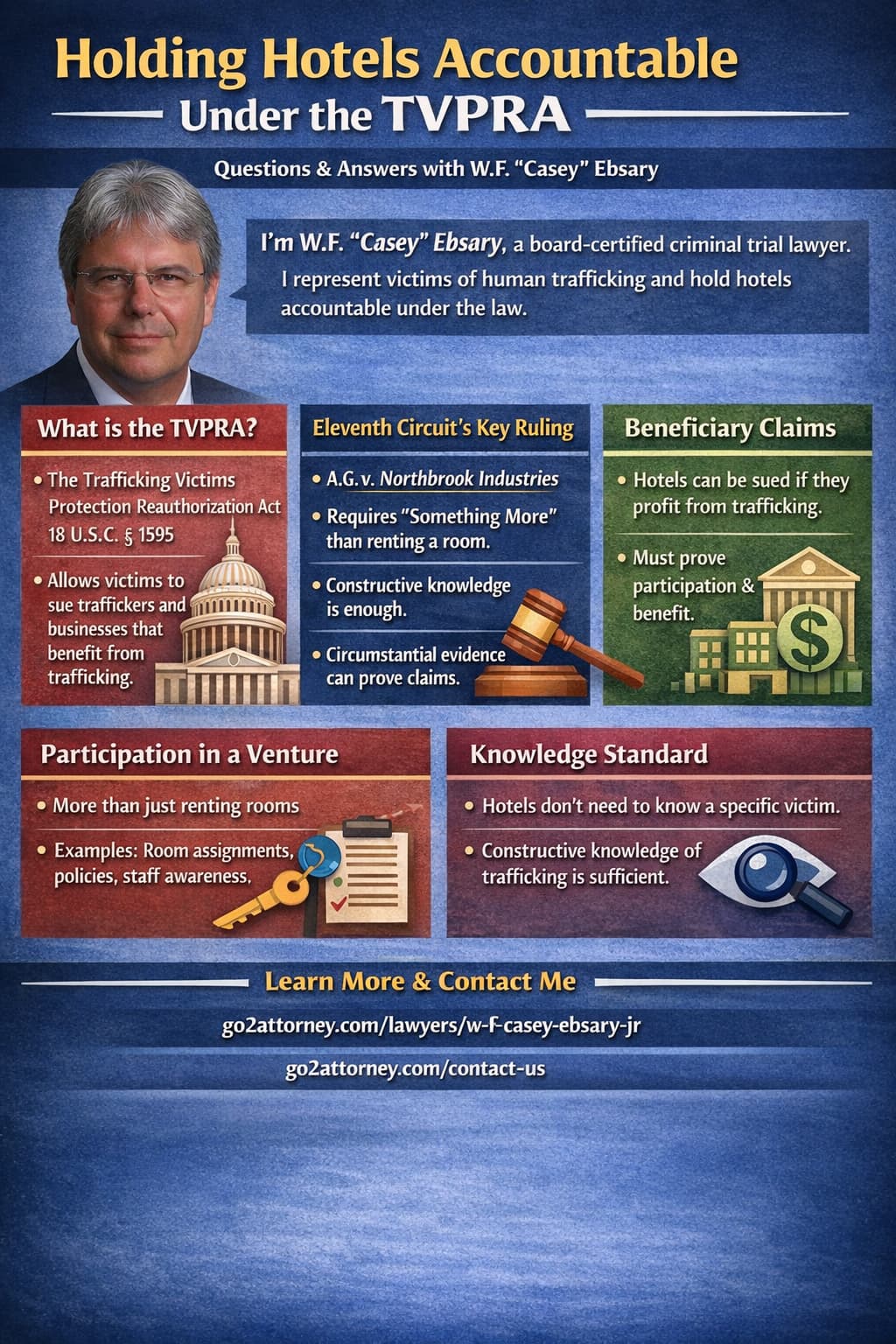
Holding Hotels Accountable Under the TVPRA Trafficking Victims Protection Reauthorization Act
Trafficking Victims Protection Reauthorization Act (TVPRA)
Questions & Answers with W.F. “Casey” Ebsary
Introduction
I am W.F. “Casey” Ebsary, a board-certified criminal trial lawyer. In my practice, I represent individuals and families confronting serious and complex legal issues, including cases involving human trafficking. These cases require careful legal analysis, disciplined investigation, and a willingness to take on well-funded corporate defendants. When trafficking intersects with the hospitality industry, federal law may provide a path to accountability that extends beyond the trafficker to the businesses that may have enabled or benefited from exploitation.
This page answers common questions I receive about civil claims against hotels under the Trafficking Victims Protection Reauthorization Act (TVPRA). I write this in the first person because this is how I speak with my clients. I will not speculate or invent authority. Where I am uncertain, I will say so. My goal is to provide clear, accurate, and useful information grounded in verifiable law.
Summary of the Eleventh Circuit Case
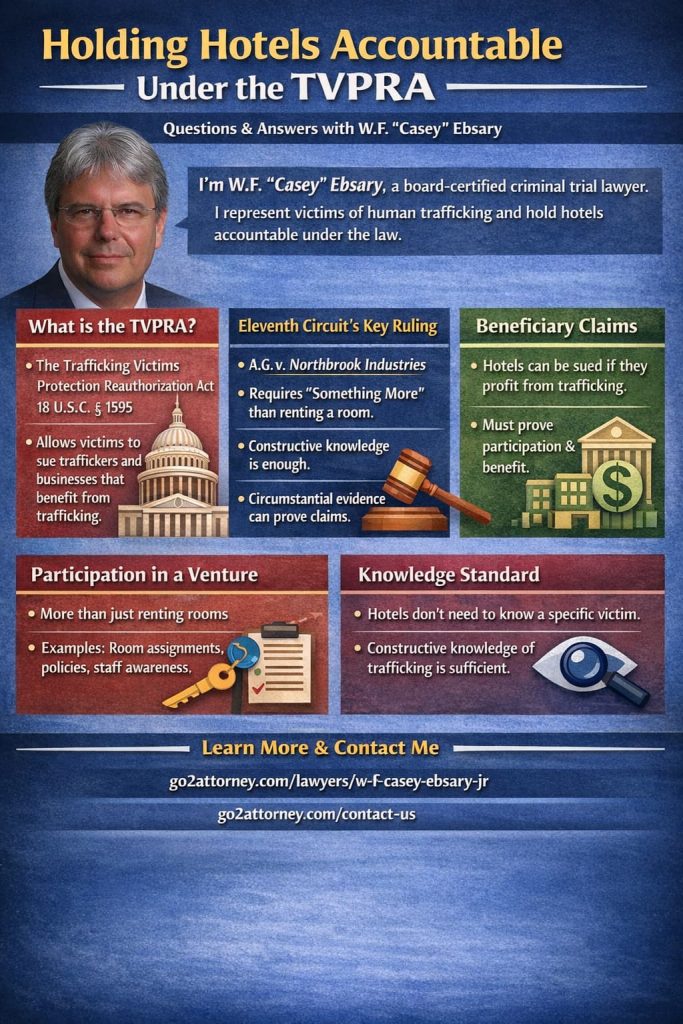
In A.G. v. Northbrook Industries, Inc., No. 24-13294 (11th Cir. Mar. 30, 2026) (consolidated with related appeals), minor victims alleged they were sex trafficked through hotel properties and brought civil beneficiary claims under the TVPRA and negligence claims under Georgia law. The Eleventh Circuit held that liability under 18 U.S.C. § 1595 requires more than a routine room rental and instead requires “something more” constituting participation in a venture. The court clarified that constructive knowledge is sufficient and does not require knowledge of a specific victim. Importantly, the court found that circumstantial evidence—such as operational practices and support provided to traffickers—could allow a reasonable jury to infer participation and knowledge. As a result, summary judgment for hotel operators was reversed in key respects.
What is the TVPRA and how does it apply to hotels?
The TVPRA provides a federal civil cause of action for victims of human trafficking. The statute can be reviewed here:
https://law.justia.com/codes/us/title-18/part-i/chapter-77/section-1595/
In my work, this statute is one of the most important tools available. It allows me to pursue claims not only against traffickers, but also against individuals and businesses that may have benefited from trafficking activity. Hotels are frequently at issue because they provide the physical setting where trafficking can occur.
The key legal question is whether a hotel crossed the line from a neutral service provider to a participant in a venture connected to trafficking. I do not assume liability. I evaluate each case based on the evidence and the governing law.
What did the Eleventh Circuit clarify in A.G. v. Northbrook Industries?
This decision provides important guidance on two central elements: “participation in a venture” and “knowledge.” The court reaffirmed that a routine commercial transaction—such as renting a room—is not enough by itself to establish liability under the TVPRA.
However, the court also made clear that when there is “something more,” such as conduct that supports or facilitates trafficking, a jury may find that the hotel participated in a venture. This is a fact-intensive inquiry. I look closely at whether the hotel’s actions went beyond ordinary operations and whether those actions could reasonably be viewed as supporting ongoing trafficking activity.
The decision also confirms that courts will allow cases to proceed when there is sufficient circumstantial evidence. That is significant because direct evidence is often unavailable in trafficking cases.
What is a “beneficiary claim” under federal law?
A beneficiary claim allows a victim to sue a defendant who knowingly benefits from participation in a trafficking venture. This includes receiving financial payments or other value connected to the exploitation.
From my perspective, this is a powerful legal mechanism. It recognizes that trafficking often involves multiple actors, not just the trafficker. However, I do not assume that every business involved in a transaction is liable. The law requires proof of both a benefit and participation.
If I cannot establish those elements with credible evidence, I will not recommend pursuing the claim. These cases must be built carefully and responsibly.
What does “participation in a venture” mean after Northbrook?
The Eleventh Circuit emphasized that “something more” than an ordinary business transaction is required. This means I must identify conduct that goes beyond simply renting a room.
According to the court’s reasoning, participation may be inferred where a hotel provides what the opinion describes as “personal support” to a trafficking operation. In the case summary, this included evidence related to room placement, cleaning practices, and operational decisions that allegedly enabled trafficking activity.
I approach this element cautiously. Not every policy or operational decision creates liability. The question is whether the conduct, viewed as a whole, could allow a reasonable jury to conclude that the hotel was part of a common enterprise. If that standard cannot be met, I will not proceed.
Does the hotel need to know about a specific victim?
No. The Eleventh Circuit clarified that knowledge under § 1595 does not require awareness of a specific victim. Instead, constructive knowledge that a venture violated the TVPRA is sufficient.
In practical terms, this means I evaluate whether the hotel should have known about trafficking activity based on observable facts. Patterns of behavior, repeated incidents, and operational red flags may all be relevant.
However, I do not assume knowledge based on speculation. The evidence must support a reasonable inference. If it does not, I will advise against pursuing the claim.
What kind of evidence supported the claims in Northbrook?
The Eleventh Circuit found that circumstantial evidence could support an inference of both participation and knowledge. The summary you provided references evidence suggesting that a hotel could be viewed as “trafficking-friendly.”
Evidence Evaluation Table
| Type of Evidence | How It May Be Used |
|---|---|
| Room assignment practices | May show efforts to facilitate or conceal activity |
| Cleaning and maintenance policies | Could indicate tolerance of ongoing conduct |
| Frequency of rentals | May reveal patterns consistent with trafficking |
| Staff observations | Can support knowledge or awareness |
| Operational decisions | May demonstrate support for ongoing activity |
I do not assume that any one factor proves liability. I evaluate whether the totality of the evidence could allow a jury to reach a legally sufficient conclusion.
How do courts evaluate knowledge and participation?
Legal Thresholds After Northbrook
| Element | Standard Explained | Key Takeaway |
|---|---|---|
| Participation | Requires “something more” than routine transactions | Fact-specific inquiry |
| Knowledge | Constructive knowledge is sufficient | No need to identify specific victim |
| Benefit | Receipt of value from the venture | Must be tied to participation |
This framework reflects how I analyze potential claims. If the evidence does not meet these standards, I will not recommend litigation.
Can victims still bring negligence claims?
Yes. In the case summary you provided, the Eleventh Circuit held that summary judgment was not appropriate on certain negligence claims under Georgia law because there was sufficient evidence for a jury to consider whether the victims were invitees.
I want to be precise here: negligence law varies by state. While this case involved Georgia law, similar concepts may arise in Florida. However, I do not assume that a negligence claim will apply in every case. The analysis depends on state law and the specific facts.
How long do I have to file a claim?
The statute of limitations under the TVPRA has been extended in many situations, but I will not provide a definitive deadline without reviewing the facts of a specific case.
Timing issues can be complex, especially where minors are involved. If there is any question about deadlines, I recommend immediate legal consultation so the issue can be evaluated carefully.
Can hotel brands or franchisors be held liable?
The Eleventh Circuit noted that a defendant’s status as a hotel operator or franchisor is not, by itself, determinative. Liability depends on the conduct and level of involvement.
I do not assume that a brand name automatically creates liability. I examine the relationship between the brand and the property, including operational control and policy enforcement. If the evidence does not support liability, I will not pursue it.
What damages might be available?
Under federal law, victims may seek compensatory damages, which can include economic and non-economic losses. In some cases, punitive damages may also be available.
However, I do not promise results or specific recoveries. Each case is unique, and outcomes depend on the evidence and how the law is applied.
Is my identity protected if I file a lawsuit?
Courts sometimes allow plaintiffs to proceed under pseudonyms in sensitive cases. This requires court approval and is not automatic.
If confidentiality is a concern, I will evaluate available options and explain what protections may be possible. I do not guarantee anonymity, but I take privacy seriously.
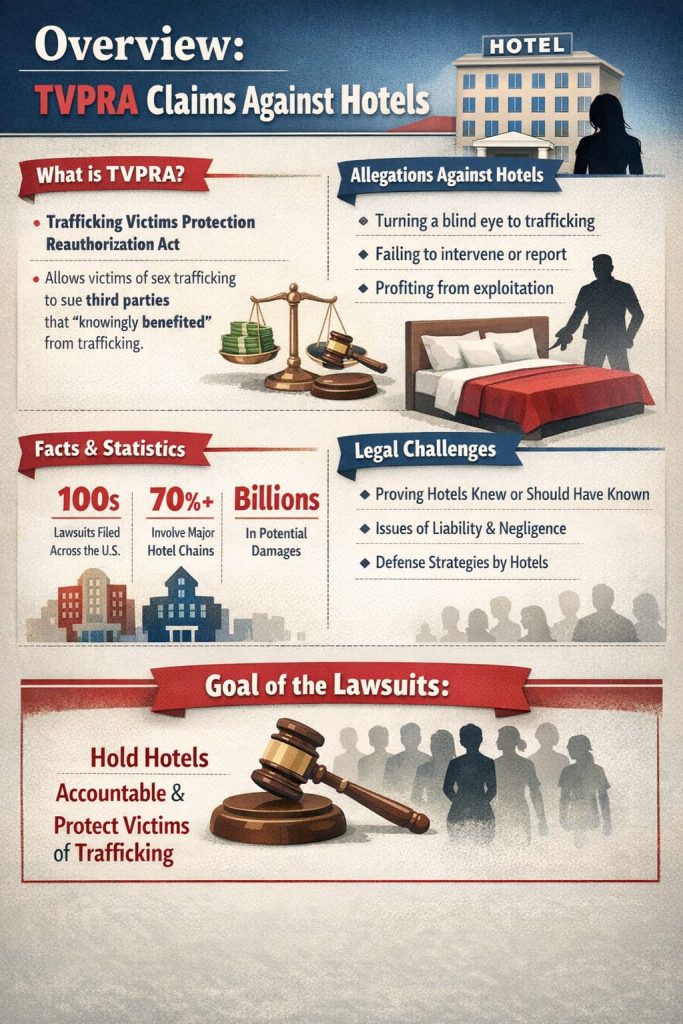
Overview: TVPRA Claims Against Hotels
Why is trial experience critical in these cases?
These cases are complex and often involve significant defense resources. They require careful preparation, strong evidentiary presentation, and the ability to present difficult facts clearly.
As a board-certified trial lawyer, I prepare every case as if it may go to trial. That preparation shapes how I investigate, evaluate, and present claims. I do not take positions I cannot support with evidence.
Frequently Asked Questions
Can I bring a claim if the trafficking happened years ago?
Possibly. Some laws allow extended timeframes, especially for minors. However, I will need to review the facts before giving a definitive answer. I do not assume that every claim is still timely.
What if I am unsure whether a hotel was involved?
That is common. I can investigate records and help determine whether a claim may exist. I do not draw conclusions without evidence.
Will my case go to trial?
Not all cases go to trial. Some resolve through settlement. However, I prepare every case thoroughly so that we are ready if trial becomes necessary.
Do I need strong evidence before contacting a lawyer?
No. Many clients come forward with limited information. I can evaluate what is available and determine whether further investigation is warranted.
Take the Next Step
Learn more about my background:
https://www.go2attorney.com/lawyers/w-f-casey-ebsary-jr/
Contact me confidentially:
https://www.go2attorney.com/contact-us/
Final Thought
The Eleventh Circuit’s decision in A.G. v. Northbrook Industries, Inc. provides important guidance, but every case remains fact-specific. I do not speculate, and I do not make promises I cannot keep. If I do not know the answer to a question, I will say so.
What I can offer is a disciplined, evidence-based approach focused on accountability where the law supports it.