Serving Hillsborough
County for Over 20 Years
County for Over 20 Years


As an attorney at Go2Attorney, I am often asked (FAQ) what someone should do in the critical minutes and hours following a crash. The steps you take immediately after an accident can significantly impact your ability to recover compensation under Florida law. Below, I answer this question clearly and directly, based on the guidance we provide at my firm.
1. Should I call 911 after a car accident in Florida?
Yes. I advise clients to call 911 immediately so law enforcement and emergency medical personnel can respond. Florida law requires reporting crashes involving injury, death, or significant property damage under Florida Statutes Section 316.065. A crash report creates an official record, which can be critical when dealing with insurance companies. You can review the statute on Justia here:
https://law.justia.com/codes/florida/title-xxiii/chapter-316/section-316-065/
You can also review crash reporting information from the Florida Department of Highway Safety and Motor Vehicles at:
https://www.flhsmv.gov/
2. Do I need to seek medical attention right away?
Yes, even if you feel fine. Under Florida’s no-fault law, you must seek medical treatment within 14 days to preserve Personal Injury Protection (PIP) benefits under Florida Statutes Section 627.736. Delaying care can harm both your health and your claim. I have seen insurance companies deny benefits when someone waited too long to be evaluated.
You can read the PIP statute on Justia here:
https://law.justia.com/codes/florida/title-xxxvii/chapter-627/section-627-736/
3. Should I document the accident scene?
Absolutely. If you are physically able, take photographs and videos of the vehicles, roadway conditions, traffic signs, skid marks, and visible injuries. This documentation preserves evidence before it disappears. In my experience, early documentation often makes a substantial difference when fault is disputed.
You may later obtain a copy of your crash report through the Florida Crash Portal operated by the Florida Department of Highway Safety and Motor Vehicles.
4. What information should I exchange with the other driver?
Florida law requires drivers to exchange identifying and insurance information under Florida Statutes Section 316.062. I recommend collecting:
Full name
Address
Driver’s license number
Vehicle registration
Insurance carrier and policy number
5. Should I speak to the insurance company right away?
You should report the accident to your insurance carrier promptly, but I caution clients about giving recorded statements to the other driver’s insurer without legal guidance. Insurance adjusters are trained to limit payouts. Before making detailed statements, I recommend consulting with an attorney so we can protect your rights and prevent misstatements from being used against you.
At Go2Attorney, I am often asked (FAQ) how someone can tell whether they truly have a valid personal injury case. The answer depends on specific legal elements under Florida law, not just whether you were injured. Below, I explain how I evaluate claims and what factors matter most.
What legal elements must be proven in a Florida personal injury case?
In Florida, a valid personal injury claim generally requires proof of negligence. That means I must be able to show the other party owed you a duty of care, breached that duty, caused your injury, and that you suffered damages. For example, drivers have statutory duties under Florida Statutes Section 316.1925, and violations may help establish fault. Without proof of these elements, a claim may not succeed even if you were hurt.
As an attorney at Go2Attorney, I get this question frequently. Florida personal injury law allows recovery for various types of damages, but the exact amount depends on the circumstances of your case, the seriousness of your injuries, and whether the statutory “serious injury” threshold is met. Here’s how I break it down for my clients.
1. Medical Expenses
You can recover for past and future medical costs directly related to the injury. This includes hospital bills, doctor visits, surgeries, physical therapy, and medical equipment. I carefully review all medical records and bills to ensure every cost is accounted for.
Florida’s Florida Statutes Section 627.736 also allows for PIP benefits, which cover a portion of medical expenses regardless of fault:
https://law.justia.com/codes/florida/title-xxxvii/chapter-627/section-627-736/
2. Lost Wages and Loss of Earning Capacity
If your injury prevents you from working, you can recover lost wages. In cases where the injury affects your ability to earn in the future, I calculate loss of earning capacity. Documentation from employers and medical professionals is essential for proving these damages.
3. Pain and Suffering
Florida requires that you meet the serious injury threshold under Florida Statutes Section 627.737 to recover non-economic damages like pain and suffering. This can include physical pain, emotional distress, and diminished quality of life. I analyze your medical records, doctor’s notes, and expert opinions to demonstrate these damages.
Justia link:
https://law.justia.com/codes/florida/title-xxxvii/chapter-627/section-627-737/
4. Property Damage
You may also recover the cost to repair or replace your vehicle or other personal property damaged in the accident. I work with appraisers and repair estimates to ensure you receive full compensation.
5. Other Out-of-Pocket Expenses
This category can include transportation to medical appointments, home modifications, or services you must pay for due to your injury. I make sure these expenses are documented and included in your claim.
As an attorney at Go2Attorney, I get asked this (FAQ) question all the time because missing the deadline can permanently bar your claim. In Florida, personal injury lawsuits are subject to strict statutes of limitations, meaning you only have a limited window to file a case in court.
Florida’s General Time Limit
For most negligence-based personal injury claims, the statute of limitations is two years from the date of the accident. This is set forth in Florida Statutes Section 95.11(3)(a), which governs civil actions for bodily injury. If you miss this deadline, the court will likely dismiss your case, even if your injuries are severe.
You can read the statute here on Justia:
https://law.justia.com/codes/florida/title-viii/chapter-95/section-95-11/
Exceptions to the Two-Year Rule
Some situations may modify the filing deadline:
Minor children – The clock may start when the child turns 18.
Government claims – If the defendant is a government entity, you may need to file a notice of claim within 3–6 months before filing a lawsuit.
Discovery rule – In certain cases, the statute of limitations may be extended if the injury was not immediately discoverable.
I carefully review each client’s facts to determine if an exception applies because these rules can be tricky.
Why Acting Quickly Matters
Even if you think you have time, I strongly recommend contacting an attorney as soon as possible. Early action allows us to:
Preserve evidence and witness statements
Review medical records promptly
Prevent insurers from disputing timeliness
As an attorney at Go2Attorney, I can tell you that the vast majority of personal injury cases in Florida never go to trial. Most claims are resolved through negotiation with insurance companies, which is why having experienced legal guidance early can make a big difference.
Why Settlements Are Common
Insurance companies aim to minimize costs and avoid the uncertainty of a jury verdict. As a result, they often offer settlements once liability and damages are reasonably clear. I carefully review medical records, crash reports, and policy limits before negotiating to ensure my clients receive fair compensation.
When a Case Might Go to Trial
While most cases settle, a trial may be necessary if:
The insurer denies liability or disputes fault
The serious injury threshold under Florida Statutes Section 627.737 is contested
The settlement offer is unreasonably low relative to your documented damages
I always prepare every case as if it could go to trial, even when negotiating, because being prepared increases leverage in settlement discussions.
As an attorney at Go2Attorney, I guide clients through the negotiation process because most personal injury claims in Florida are resolved outside of court. Insurance companies have their own strategies, so it’s critical to understand the process and protect your rights at every step.
Step 1: Report the Accident and Provide Initial Information
Once an accident occurs, you should promptly notify your insurance company. I advise clients to report the incident factually—date, location, and what happened—without admitting fault. Insurers will request a written or recorded statement. I typically review these requests with my clients to ensure statements are accurate and do not inadvertently harm their claim.
Step 2: Document Your Injuries and Damages
Before serious negotiation begins, I collect all relevant evidence:
Medical records and bills
Lost wages documentation
Photographs or videos of injuries and property damage
Crash reports from law enforcement (Florida Statutes Section 316.065)
Witness statements
Insurance adjusters use documentation to evaluate the claim, so completeness is crucial.
Step 3: Insurance Company Evaluation
Adjusters review the evidence, liability, and policy limits. They may request additional information or medical authorizations. I often communicate directly with the insurer on behalf of my clients to ensure their rights are protected and avoid any misstatements.
Step 4: Settlement Demand
I prepare a formal demand package detailing your injuries, damages, medical bills, lost wages, and pain and suffering (if the serious injury threshold under Florida Statutes Section 627.737 is met). This package sets the foundation for negotiation.
Step 5: Negotiation
Negotiation is often back-and-forth. The insurance company may make a low initial offer. I evaluate each offer, explain the risks and benefits to my client, and counteroffer as needed. Strong documentation and preparation often lead to fairer settlements.
Step 6: Settlement Agreement
Once an agreement is reached, I review the release carefully. Signing prematurely can waive your right to future claims. I ensure my clients understand what they are signing and confirm that all agreed-upon damages are included.
As an attorney at Go2Attorney, I often get questions about what happens to medical bills and other expenses after a personal injury. Florida law and insurance practices create several important considerations, and understanding them early can protect your recovery.
Medical Bills: Personal Injury Protection (PIP) Coverage
Florida is a no-fault state for auto accidents, which means your Personal Injury Protection (PIP) benefits under Florida Statutes Section 627.736 generally cover medical bills up to $10,000, regardless of fault. This includes hospital care, doctor visits, surgery, and therapy, as long as treatment begins within 14 days of the accident.
I always review my clients’ medical bills and coordinate with their healthcare providers and insurers to make sure claims are submitted correctly.
Justia link:
https://law.justia.com/codes/florida/title-xxxvii/chapter-627/section-627-736/
Property Damage and Out-of-Pocket Expenses
Expenses like vehicle repairs, replacement of personal items, transportation to medical appointments, or home modifications can also be reimbursed. I document and calculate these costs carefully so they are included in your claim.
Insurance companies may attempt to minimize reimbursement, so I negotiate to ensure you are fully compensated for out-of-pocket expenses directly caused by the accident.
Medical Liens and Subrogation
Sometimes, healthcare providers, Medicare, or Medicaid may place liens on your settlement. This means a portion of your recovery may go directly to pay those bills. I handle lien negotiation to reduce what you may owe, ensuring that you keep as much of your settlement as possible.
Payment Timing
During a personal injury case, you typically do not pay anything upfront for legal services; I work on a contingency basis. Medical bills may be handled through PIP, liens, or directly negotiated with providers. Once the case resolves, I ensure all debts and expenses are paid before you receive your net settlement.
As an attorney at Go2Attorney, I often see clients worried that being partially at fault will prevent them from recovering anything. In Florida, the law is designed to allow recovery even if you share some responsibility—but there are important rules to understand.
Florida’s Comparative Fault Rule
Florida follows a modified comparative negligence system under Florida Statutes Section 768.81. This means:
If you are 50% or less at fault, you can still recover damages, but your total recovery is reduced by your percentage of fault.
If you are more than 50% at fault, you are generally barred from recovering any damages.
For example, if damages are $50,000 and you are found 20% at fault, your recovery would be $40,000 ($50,000 minus 20%).
How I Assess Fault
When I evaluate a claim, I carefully review:
Crash reports and police findings
Witness statements
Physical evidence like skid marks or vehicle damage
Medical records to determine the nature and extent of injuries
This assessment helps me determine your potential recovery and how to negotiate with the insurance company.
Negotiating With Insurers
Insurance companies often try to assign a higher percentage of fault to the victim to reduce the payout. I handle all communication with insurers to ensure fault is assigned accurately and your damages are not unfairly reduced.
As an attorney at Go2Attorney, I know that one of the first questions clients ask is about timing. While every case is unique, there are common stages that affect how long a personal injury claim takes in Florida.
Typical Timeline for a Personal Injury Case
Initial Consultation & Investigation (1–4 weeks)
After an accident, I review your case, gather evidence, and evaluate liability. This includes police reports, medical records, witness statements, and insurance information. Early investigation helps preserve key evidence.
Medical Treatment & Documentation (Weeks to Months)
You must complete necessary treatment to document injuries. Florida’s no-fault system under Florida Statutes Section 627.736 provides PIP benefits, but treatment timelines can affect when a settlement is realistic.
Negotiation with Insurance Companies (1–6 months)
Once your injuries and damages are well-documented, I prepare a formal demand package and negotiate with the insurance company. Settlement discussions can be quick or extended depending on liability disputes, injury severity, and insurer strategy.
Filing a Lawsuit (If Necessary)
If a fair settlement cannot be reached, filing a lawsuit may be required. Litigation can add several months or even years, depending on court schedules, motions, and whether the case goes to trial.
As an attorney at Go2Attorney, in another FAQ, I always emphasize that strong evidence is the foundation of a successful personal injury case. The more thorough and well-documented your evidence, the better your chances of proving liability, damages, and maximizing your recovery under Florida law.
1. Police and Accident Reports
Official crash reports created by law enforcement are critical because they provide an independent record of the accident, including the location, date, involved parties, and officer’s observations. Under Florida Statutes Section 316.065, certain crashes must be reported to law enforcement. I always obtain and review these reports to help establish fault.
Justia link:
https://law.justia.com/codes/florida/title-xxiii/chapter-316/section-316-065/
2. Medical Records and Bills
Your medical documentation proves both the nature and extent of your injuries. This includes doctor’s notes, hospital records, lab results, imaging, prescriptions, and therapy records. I use these records to calculate damages like medical expenses, lost wages, and pain and suffering.
3. Photographs and Videos
Visual evidence of the accident scene, vehicle damage, skid marks, traffic signs, road conditions, and visible injuries can significantly strengthen your claim. I often recommend that clients take photos immediately after an accident and preserve them for later use.
4. Witness Statements
Eyewitness accounts can confirm what happened and support your version of events. Statements from passengers, bystanders, or other drivers can be crucial if fault is disputed. I collect these statements carefully to ensure they are admissible and accurate.
5. Documentation of Expenses and Damages
Keep thorough records of all expenses related to your injury, including:
Medical bills
Lost wages from time off work
Vehicle repair costs
Transportation to appointments
Other out-of-pocket costs
I organize these records for insurers and, if necessary, for the court to substantiate your claim.
As an attorney at Go2Attorney, I bring decades of experience handling personal injury cases in Florida. I have been practicing law for over 20 years, representing clients in a wide range of accidents including motor vehicle crashes, slip-and-fall incidents, and other negligence claims.
Over the years, I have helped clients navigate Florida’s complex no-fault and comparative fault rules, ensuring their rights are protected, damages are maximized, and deadlines are met. I focus on both negotiation and litigation, preparing every case as if it could go to trial to give my clients the best possible outcome.
My Approach
I combine legal expertise with practical guidance, helping clients understand:
How Florida’s PIP benefits and serious injury threshold work
How to document medical treatment, lost wages, and property damage
How to negotiate with insurance companies effectively
When litigation is necessary to protect your recovery
You can learn more about my background and experience here:
👉 https://www.go2attorney.com/lawyers/w-f-casey-ebsary-jr/
If you want to discuss your FAQ on your personal injury case with an experienced attorney who has handled hundreds of claims over the past two decades, contact my office here:
👉 https://www.go2attorney.com/contact-us/
I guide my clients every step of the way, using proven strategies based on years of experience to protect their rights and maximize compensation.
As an attorney at Go2Attorney, I focus on a wide range of personal injury cases in Florida, helping clients recover compensation for injuries caused by someone else’s negligence. My practice emphasizes hands-on, evidence-based representation to maximize results.
1. Motor Vehicle Accidents
I handle car, truck, motorcycle, and rideshare (Uber/Lyft) accidents. Florida’s Florida Statutes Section 627.736 system requires careful navigation of PIP benefits and serious injury thresholds to pursue full compensation. I guide clients through documentation, insurance claims, and, if necessary, litigation.
Justia link:
https://law.justia.com/codes/florida/title-xxxvii/chapter-627/section-627-736/
2. Slip-and-Fall / Premises Liability
If you’ve been injured on someone else’s property due to unsafe conditions, I assess liability under premises law. This includes slips, trips, falls, or hazards in commercial or residential properties. I investigate property maintenance records, warnings, and witness statements to support your claim.
3. Wrongful Death Cases
When a loved one dies due to another party’s negligence, I represent surviving family members to recover damages for funeral costs, loss of support, and pain and suffering. I work carefully to handle these sensitive matters with compassion and attention to detail.
4. Product Liability
If a defective or dangerous product caused injury, I evaluate the manufacturer, distributor, or retailer’s responsibility. Evidence gathering often includes product testing, expert opinions, and recall history.
5. Other Negligence-Based Injuries
I also handle cases involving dog bites, boating accidents, pedestrian accidents, and other incidents where another party’s negligence caused harm. My approach always focuses on documenting damages, establishing fault, and protecting your legal rights.
As an attorney at Go2Attorney, I focus on results, and my track record reflects years of experience in personal injury law. While every case is unique, I have successfully helped hundreds of clients recover significant compensation through settlements or verdicts.
My Approach to Success
I measure success not just by winning a case, but by maximizing the recovery for my clients. This includes:
Thorough investigation – gathering police reports, medical records, witness statements, and evidence
Strong documentation of damages – including medical expenses, lost wages, property damage, and pain and suffering
Skilled negotiation with insurers – ensuring offers are fair and supported by evidence
Trial readiness – I prepare every case as if it may go to court, which often increases settlement leverage
Because of this approach, the majority of my cases settle favorably before trial, and those that proceed to court have resulted in positive verdicts for clients.
As an attorney at Go2Attorney, I guide my clients through every stage of a personal injury case, including depositions, negotiations, and trial. Preparation is critical because your statements and actions can directly affect the outcome of your case.
1. Depositions
A deposition is a sworn statement given under oath, usually to an insurance company or opposing attorney. I coach clients carefully on how to answer questions:
Stick to the facts and avoid speculation
Keep answers brief and clear
Never admit fault or make assumptions
Practice responses to common questions before the deposition
I often conduct mock depositions so clients feel confident and prepared for the real thing.
2. Negotiations
Negotiating with insurance companies requires understanding your case value and evidence. I prepare clients by:
Explaining how damages are calculated, including medical expenses, lost wages, and pain and suffering
Reviewing potential settlement offers and the pros/cons of accepting or rejecting them
Helping clients stay calm and focused while I lead communications with the insurer
This preparation ensures clients make informed decisions and are not pressured into accepting unfair offers.
3. Trial
While most personal injury cases settle, some require litigation. I prepare clients for trial by:
Reviewing courtroom procedures and what to expect on each day
Explaining how testimony works and coaching clients on answering questions clearly
Discussing the role of expert witnesses and evidence presentation
Practicing cross-examination scenarios and courtroom etiquette
Preparation reduces anxiety and ensures clients present themselves confidently and accurately.
As an attorney at Go2Attorney, I make sure my clients understand that the investigation and evidence-gathering phase is critical to building a strong personal injury case. This process lays the foundation for settlement negotiations or trial and can significantly impact the outcome of your claim.
1. Gathering Police and Accident Reports
I start by obtaining official police or crash reports under Florida Statutes Section 316.065, which provide an independent account of the accident. These reports often include citations, diagrams, and officer observations that are crucial for establishing liability.
Justia link:
https://law.justia.com/codes/florida/title-xxiii/chapter-316/section-316-065/
2. Collecting Medical Records and Bills
I coordinate with your healthcare providers to obtain complete medical documentation, including hospital records, therapy notes, prescriptions, and diagnostic tests. This ensures we accurately document injuries, treatment, and future care needs, which directly supports your claim for damages.
3. Documenting Property Damage and Expenses
Photographs, repair estimates, and receipts for damaged property, medical appointments, or transportation costs help demonstrate financial losses. I advise clients to keep thorough records and take photos immediately after the accident whenever possible.
4. Interviewing Witnesses
Eyewitnesses, passengers, or bystanders can provide valuable statements to support your version of events. I conduct interviews professionally to ensure statements are accurate, admissible, and consistent with other evidence.
5. Expert Analysis (If Needed)
For complex cases, I may retain accident reconstruction specialists, medical experts, or economic analysts to quantify damages and establish liability. This can be critical in serious injury cases or disputes over fault.
As an attorney at Go2Attorney, I have extensive experience working directly with insurance companies and defense attorneys in personal injury cases across Florida. This experience is critical because most claims are resolved through negotiation rather than trial, and insurers often try to minimize payouts.
My Approach
I handle every interaction with insurers and opposing counsel on behalf of my clients. This includes:
Communicating effectively – I speak directly with adjusters and defense attorneys to protect my clients’ rights.
Evaluating offers carefully – I review settlement proposals to ensure they fully compensate for medical bills, lost wages, property damage, and pain and suffering.
Strategic negotiation – I use evidence, expert opinions, and legal standards to maximize leverage in settlement discussions.
Trial readiness – Even during negotiations, I prepare every case as if it could go to court, which often encourages insurers to make fair offers.
As an attorney at Go2Attorney, I know that understanding the true value of a personal injury claim is essential before negotiating with insurers or considering settlement offers. I help clients evaluate every aspect of their case to ensure they receive full and fair compensation.
1. Reviewing Medical Expenses and Future Care
I start by collecting all medical bills, therapy records, and treatment plans. I also consider future medical care if your injuries require ongoing treatment. This ensures your claim reflects the total cost of care, not just what has already been spent.
2. Calculating Lost Wages and Earning Capacity
Lost income due to missed work is an important part of a claim. I document time off, missed promotions, or diminished earning capacity, and include these amounts when assessing your case. This also covers self-employment or freelance income if applicable.
3. Quantifying Pain and Suffering
Pain, emotional distress, and diminished quality of life are compensable damages under Florida law, including the serious injury threshold in Florida Statutes Section 627.737. I work with medical records, expert opinions, and client testimony to assign an accurate value to non-economic damages.
Justia link:
https://law.justia.com/codes/florida/title-xxxvii/chapter-627/section-627-737/
4. Considering Property Damage and Other Expenses
Vehicle repairs, personal property replacement, transportation costs, and out-of-pocket expenses are added to the claim. I review receipts, estimates, and documentation to ensure all recoverable costs are included.
5. Analyzing Liability and Comparative Fault
Florida’s comparative fault system under § 768.81 affects the ultimate value of your claim. I assess who was at fault, and if you are partially responsible, I adjust the calculation so clients understand their realistic recovery.
As an attorney at Go2Attorney, I understand that one of the most challenging aspects of a personal injury case is when liability is contested. Disputes over fault can significantly affect your ability to recover damages, so I take a thorough, strategic approach to protect my clients.
1. Conducting a Detailed Investigation
I start by gathering all available evidence to establish fault, including:
Police and accident reports (Florida Statutes Section 316.065)
Witness statements from passengers, bystanders, or other drivers
Photographs and videos of the accident scene, vehicles, and injuries
Expert analysis, such as accident reconstruction or medical evaluations
Collecting comprehensive evidence helps build a strong factual foundation to counter claims that you were at fault.
2. Evaluating Comparative Fault
Florida uses a modified comparative fault system under § 768.81, which means you can still recover damages even if partially at fault (up to 50%). I carefully analyze how liability may be shared and adjust your expected recovery accordingly.
3. Negotiating Strategically
Disputed liability often leads to more intense negotiations with insurance companies or defense attorneys. I:
Present a well-documented demand package
Highlight supporting evidence and expert reports
Challenge the opposing party’s arguments with facts and legal precedent
My goal is to maximize settlement value even when fault is contested.
4. Preparing for Litigation
If a fair settlement cannot be reached, I prepare the case for court. Litigation is often necessary when liability is disputed, and I make sure clients understand the trial process, their role, and the potential outcomes.
As an attorney at Go2Attorney, I understand that recovering from an accident involves more than just filing a legal claim. While I do not provide medical treatment myself, I can help connect clients with appropriate medical providers and recovery resources so they receive timely care and proper documentation for their case.
1. Medical Treatment Referrals
If you do not have a treating physician, I can provide referrals to:
Primary care doctors
Orthopedic specialists
Chiropractors
Physical therapists
Diagnostic imaging providers
Prompt treatment is especially important under Florida’s PIP requirements in Florida Statutes Section 627.736, which generally require medical treatment within 14 days of a crash to access certain benefits.
Justia link:
https://law.justia.com/codes/florida/title-xxxvii/chapter-627/section-627-736/
2. Coordinating Documentation
Proper medical documentation is essential to proving your claim. I help ensure:
Treatment records are complete and accurate
Bills are properly submitted to insurance
Medical opinions clearly address causation and permanency when necessary
This coordination helps protect both your health and your legal recovery.
3. Additional Recovery Resources
Beyond medical referrals, I may guide clients toward:
Vehicle repair coordination
Rental car assistance
Property damage claims handling
Insurance benefit explanations
Wage verification documentation
My goal is to reduce stress so you can focus on healing while I handle the legal and procedural aspects of your case.
At Go2Attorney, I handle most personal injury cases on a contingency fee basis. This means I do not charge hourly fees and you do not pay attorney’s fees upfront. Instead, my fee is a percentage of the recovery I obtain for you through settlement or verdict. If there is no recovery, there is typically no attorney’s fee.
How Contingency Fees Work in Florida
Contingency fee arrangements in personal injury cases are regulated by the The Florida Bar under Rule 4-1.5 of the Rules Regulating The Florida Bar. These rules establish guidelines and percentage limits depending on the stage of the case (pre-suit, after filing a lawsuit, or if an appeal is required).
Official source:
https://www.floridabar.org/rules/rrtfb/
Before representation begins, I provide a written fee agreement that clearly explains the percentage, costs, and how expenses are handled. Transparency is important to me, and I review every provision with my clients so there are no surprises.
At Go2Attorney, I handle most personal injury cases on a contingency fee basis, which means you typically do not pay attorney’s fees upfront. However, there can be case-related costs and litigation expenses that arise while we pursue your claim. I explain all of these clearly in a written agreement before we begin.
Contingency fees in Florida are regulated by The Florida Bar under Rule 4-1.5, which governs fee agreements and requires transparency in how fees and costs are handled.
Official source:
https://www.floridabar.org/rules/rrtfb/
Liability disputes
In many cases, these costs are advanced by my office and reimbursed from the recovery at the end of the case, depending on the terms of the agreement.
Medical Bills During the Case
Medical bills are separate from legal fees. Under Florida’s no-fault system, Personal Injury Protection (PIP) benefits are governed by Florida Statutes Section 627.736, which outlines how certain medical expenses are paid after an accident.
Some providers may agree to treat under a letter of protection, meaning payment is deferred until the case resolves. I review these arrangements carefully with my clients.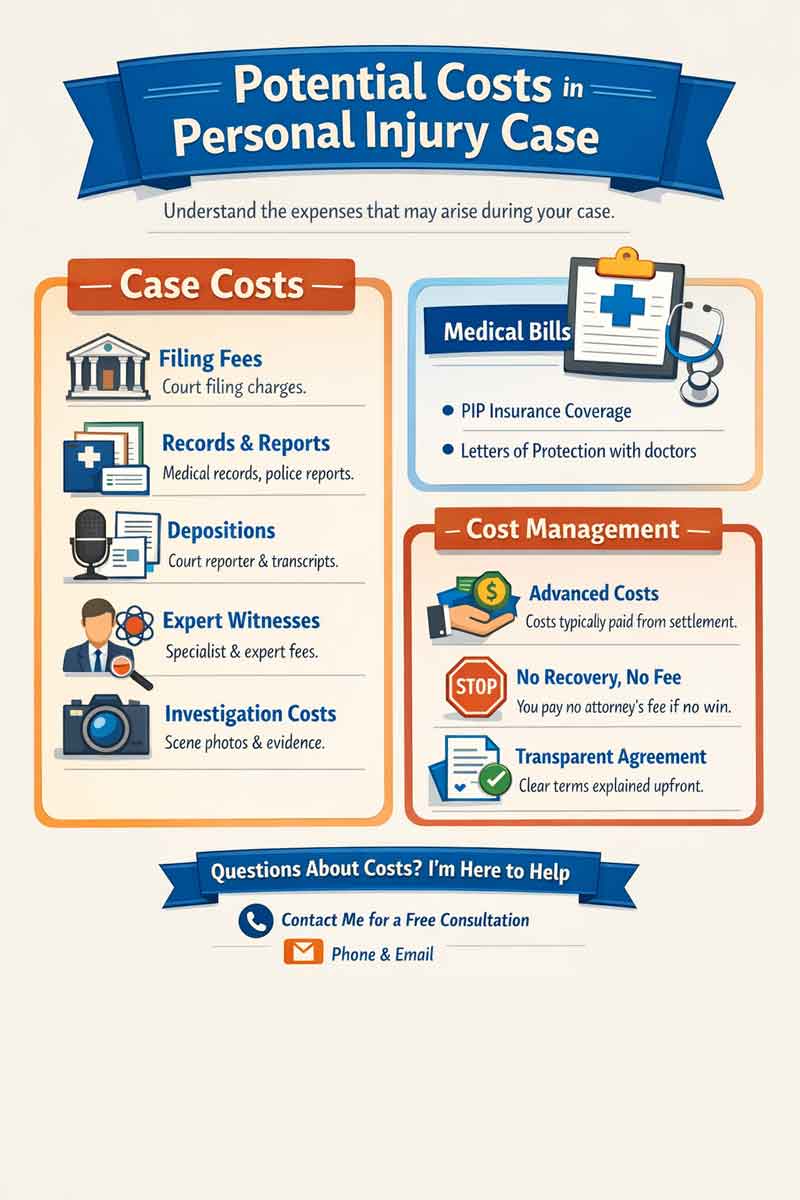
At Go2Attorney, I handle most personal injury cases on a contingency fee basis, meaning my legal fee is a percentage of the recovery I obtain for you. My fee generally includes all attorney time spent on investigating your claim, negotiating with insurance companies, preparing legal documents, conducting depositions, and, if necessary, representing you at trial. You do not pay hourly fees for this work.
Contingency fees in Florida are regulated by The Florida Bar under Rule 4-1.5 of the Rules Regulating The Florida Bar, which sets guidelines and requires written fee agreements.
Official source: https://www.floridabar.org/rules/rrtfb/
What Is Typically Included in My Legal Fee
Case Investigation
Reviewing reports, evidence, and liability
Insurance Negotiations
Handling all communications and settlement discussions
Legal Filings & Pleadings
Drafting and filing necessary documents
Depositions (Attorney Time)
Preparing and conducting depositions
Trial Representation
Court appearances and advocacy
Additional Case Costs (Separate From Attorney’s Fees)
While my fee covers legal services, there may be case-related expenses, such as:
Filing a lawsuit in court
Service of Process
Serving the defendant
Medical Record Fees
Obtaining certified medical records
Deposition Costs
Court reporter and transcript fees
Expert Witness Fees
Medical or accident reconstruction experts
Investigation Expenses
Scene inspections, photographs, evidence preservation
These expenses are often advanced by my office and reimbursed from the settlement or verdict, depending on the terms of the written agreement. I explain clearly how costs are handled before representation begins.
Medical Bills & Insurance Considerations
Medical expenses are separate from legal fees. Florida’s Personal Injury Protection (PIP) system is governed by Florida Statutes Section 627.736, which outlines how certain medical bills are paid following an accident.
I help coordinate documentation and may discuss options such as letters of protection if appropriate.
At Go2Attorney, I offer a free initial consultation for personal injury cases. During this meeting, I review the facts of your accident, discuss potential liability, explain how Florida law applies, and outline your legal options. There is no charge for this evaluation, and no obligation to hire me afterward.
Because most injury cases are handled on a contingency fee basis under the rules of The Florida Bar, you generally do not pay attorney’s fees unless there is a recovery. I explain the fee agreement in writing and answer all questions before representation begins.
Official source: https://www.floridabar.org/rules/rrtfb/
At Go2Attorney, most personal injury cases are handled on a contingency fee basis, which means you do not pay hourly fees or upfront retainers. Instead, my fee is a percentage of the recovery I obtain for you. This structure allows clients to pursue their claims without worrying about immediate legal bills.
Contingency fee agreements in Florida are regulated by The Florida Bar under Rule 4-1.5, which requires written agreements and transparency regarding fees and costs.
Official source: https://www.floridabar.org/rules/rrtfb/
Do I Offer Payment Plans?
Because personal injury cases are typically contingency-based, payment plans are generally not necessary for attorney’s fees. You do not make monthly payments for my legal services. However, I do:
Clearly explain how case costs are handled
Outline whether costs are advanced by my office
Review all financial terms in writing before representation begins
If I handle a matter outside of a contingency arrangement, billing terms are discussed upfront so there are no surprises.
At Go2Attorney, most personal injury cases are handled on a contingency fee basis, so a retainer is typically not required. Instead of paying an upfront retainer, my fee is a percentage of the recovery I obtain for you. This allows injured clients to pursue their claims without paying attorney’s fees in advance.
Contingency and retainer arrangements in Florida are governed by the rules of The Florida Bar, specifically Rule 4-1.5 of the Rules Regulating The Florida Bar, which requires written fee agreements and clear disclosure of how funds are handled.
Official source: https://www.floridabar.org/rules/rrtfb/
When Would a Retainer Be Required?
In most personal injury cases, no retainer is required.
In certain non-contingency matters (outside of personal injury), a retainer may be required depending on the type and complexity of the case. If applicable, the amount would be clearly stated in a written agreement before representation begins.
Is Unused Retainer Money Refundable?
Yes. Under Florida Bar rules, any unearned portion of a retainer must be handled in accordance with trust accounting requirements. If a retainer is used for hourly billing in a non-contingency matter, unused funds are generally refundable consistent with the written agreement and ethical rules. The fee agreement may provide some retainers are nonrefundable and fully earned upon comemncement of the representation.
At Go2Attorney, I believe communication is one of the most important parts of effective legal representation. I keep my clients informed at every significant stage of their personal injury case so they understand what is happening and what to expect next. You will not be left wondering about the status of your matter.
How I Communicate With Clients
I provide updates through:
Phone calls to discuss major developments or settlement offers
Email updates for documentation, filings, and correspondence
Copies of important pleadings and notices
Scheduled case reviews when key milestones occur
The professional responsibility to keep clients reasonably informed is also reflected in the rules of The Florida Bar, including Rule 4-1.4 regarding attorney communication.
Official source: https://www.floridabar.org/rules/rrtfb/
I also respond to client inquiries promptly. If you have a question, I encourage you to reach out rather than wait for a scheduled update.
At Go2Attorney, I believe clients deserve direct access to their attorney. In personal injury matters, I personally oversee your case, handle strategy decisions, conduct negotiations, and prepare for litigation if necessary. You will not be handed off to an anonymous call center or shuffled between multiple attorneys without explanation.
How My Firm Is Structured
While I remain your primary legal contact, you may also interact with trusted support staff who assist with:
Scheduling appointments and depositions
Collecting medical records and documentation
Coordinating filings and court notices
Providing administrative updates
This team approach ensures efficiency, but I remain responsible for legal advice, case evaluation, negotiations, and courtroom representation.
At Go2Attorney, I understand that personal injury cases can be stressful, and timely communication is critical. I make it a priority to respond promptly to emails, phone calls, and messages, so my clients always know where their case stands.
At Go2Attorney, I make it a priority to keep my clients informed throughout the personal injury process. While the frequency of updates depends on the stage and complexity of your case, I ensure you receive timely information at every critical point.
At Go2Attorney, I want communication to be easy, efficient, and responsive for my clients. The best method depends on the situation, but I am available through multiple channels and prioritize staying accessible. I encourage clients to use the method that is most convenient for them, and I will respond promptly regardless of the channel. For critical or time-sensitive matters, email is usually the fastest way to reach me.
At Go2Attorney, I generally advise clients not to speak directly with the other party’s insurance company without legal guidance. Insurance adjusters are trained to minimize payouts and may use your statements against you, even if you are careful.
Why You Should Be Cautious
Anything you say can be used to dispute liability or reduce compensation.
Early statements about the accident, injuries, or medical treatment can be misinterpreted or taken out of context.
Adjusters may try to get a quick settlement that does not fully cover your damages.
How I Handle Communication With Insurers
My team handles all communication with the other party’s insurance company. This includes:
Reviewing settlement offers
Responding to requests for statements or documentation
Negotiating aggressively for fair compensation
By letting me communicate on your behalf, you reduce risk and protect your legal rights.
At Go2Attorney, I often work with clients who did not seek immediate medical attention after an accident. You can still file a personal injury claim, but timely medical documentation is important to establish the connection between the accident and your injuries.
How Delayed Treatment Affects a Case
Insurance companies may question whether your injuries were caused by the accident or another incident.
Medical records created after the accident can still support your claim, but the closer the treatment is to the date of the crash, the stronger the evidence.
Expert testimony or medical evaluations can help link your injuries to the accident if there was a delay in treatment.
Under Florida law, Personal Injury Protection (PIP) benefits under Florida Statutes Section 627.736 may require treatment within 14 days to access certain benefits, but you can still pursue other claims beyond PIP coverage.
At Go2Attorney, I strongly advise clients to avoid posting details about their accident, injuries, or claim on social media. Even innocent comments or photos can be used by insurance companies or defense attorneys to challenge your case or reduce your recovery.
Why Social Media Can Be Risky
Statements can be taken out of context and used against you.
Photos or videos may contradict your reported injuries or limitations.
Public posts can be used as evidence in settlement negotiations or at trial.
Insurance adjusters often monitor social media accounts to find information that can minimize your claim, even months after the accident.
How I Advise Clients
Limit online activity until your case is resolved.
Do not comment on the accident, injuries, or medical treatment.
Do not accept friend requests from opposing parties or adjusters.
Focus on medical care, documentation, and following my guidance rather than sharing publicly.
At Go2Attorney, I emphasize thorough documentation because strong evidence is the backbone of a successful personal injury claim. The more detailed and organized your records, the easier it is to prove the extent of your injuries and financial losses.
Key Steps to Document Injuries and Damages
Seek Prompt Medical Treatment
Get examined by a doctor or specialist as soon as possible.
Keep all medical records, test results, prescriptions, and treatment notes.
Florida’s PIP benefits under Florida Statutes Section 627.736 may require treatment within 14 days for coverage.
Justia link: https://law.justia.com/codes/florida/title-xxxvii/chapter-627/section-627-736/
Document Injuries With Photos or Videos
Take clear pictures of visible injuries, bruises, or swelling.
Record any physical limitations that prevent daily activities.
Keep a Detailed Injury Journal
Note pain levels, mobility issues, and emotional impact each day.
Track missed work, lost wages, and additional expenses related to the injury.
Collect Bills and Receipts
Save medical bills, prescriptions, therapy invoices, and receipts for out-of-pocket costs (transportation, home care, assistive devices).
Preserve Evidence Related to the Accident
Photos of property damage, the scene, skid marks, or traffic signals.
Witness names and contact information.
Police or accident reports.
Follow All Medical Advice
Attending all recommended treatments and following your doctor’s instructions demonstrates seriousness and strengthens your claim.
At Go2Attorney, I often handle cases where the at-fault party lacks insurance, and while these situations can be more challenging, you still have options to pursue compensation. Florida law requires drivers to carry insurance, but uninsured drivers do exist, and we take steps to protect your rights.
Options When the At-Fault Party Is Uninsured
Your Own Insurance Coverage
Florida law mandates Personal Injury Protection (PIP) and property damage coverage, but additional options may include Uninsured/Underinsured Motorist (UM/UIM) coverage.
UM/UIM can cover medical bills, lost wages, and pain & suffering if the other driver lacks adequate insurance.
Filing a Lawsuit Directly
You can pursue a claim against the at-fault driver personally.
Collection depends on the individual’s assets, which may involve liens on property or wage garnishment.
Negotiation and Settlement
Even uninsured parties may settle if there is a risk of litigation and exposure to court judgments.
I handle all negotiations strategically to maximize your recovery.
Government or Special Programs
Some claims may qualify for compensation through state victim compensation programs, depending on the circumstances.
At Go2Attorney, I help clients pursue compensation for both physical injuries and the emotional impact of an accident, which often includes claims for pain and suffering or emotional distress. Florida law recognizes that personal injuries are not just physical—mental and emotional effects can also be compensated.
What You Can Recover
Pain and Suffering
Compensation for physical discomfort, limitations, and lifestyle impact caused by the accident.
Emotional Distress
Includes anxiety, depression, sleep disruption, or trauma resulting from the incident.
Often supported with documentation from mental health professionals.
Loss of Enjoyment of Life
Damages for the inability to participate in hobbies, social activities, or normal daily routines.
In Florida, these non-economic damages are often considered alongside medical expenses, lost wages, and property damage to calculate the full value of a claim.
Legal References
Florida Statutes do not set strict caps on pain and suffering for most personal injury cases, but recovery must be supported by evidence.
Courts may consider the severity, duration, and impact of your injuries in determining compensation.
At Go2Attorney, I help clients navigate situations where liability is not always straightforward, such as workplace injuries or accidents on private property. Determining who is responsible depends on the circumstances and applicable laws.
Workplace Injuries
In Florida, most work-related injuries are covered under workers’ compensation.
Workers’ compensation usually provides medical treatment and partial wage replacement, but generally does not allow you to sue your employer for additional damages.
Exceptions exist if a third party (someone other than your employer or coworker) contributed to the injury. In that case, you may have a third-party personal injury claim.
Reference: Florida Workers’ Compensation Law – Florida Statutes Chapter 440
Injuries on Someone Else’s Property (Premises Liability)
Property owners have a legal duty to maintain safe conditions for visitors.
You may have a claim if your injury resulted from hazards they knew about (or should have known), such as wet floors, broken stairs, or inadequate security. Liability depends on your status as a guest, invitee, or trespasser, which affects the property owner’s duty of care under Florida law.
At Go2Attorney, I help clients understand how Florida’s comparative negligence laws can impact personal injury claims. Your degree of fault in an accident can affect the compensation you may recover.
Florida’s Comparative Fault System
Florida follows a pure comparative negligence rule under Florida Statutes Section 768.81.
This means that if you are partially at fault for an accident, your recovery is reduced by your percentage of fault, but you can still recover damages even if you are mostly at fault.
Example: If your damages total $50,000 and you are 20% at fault, your recovery is reduced by $10,000, leaving $40,000.
Contributory Negligence vs. Comparative Negligence
Contributory Negligence (used in very few states, not Florida) would bar recovery entirely if you were at all at fault.
Comparative Negligence (Florida’s approach) allows partial recovery, proportionate to your level of fault.
At Go2Attorney, I help clients protect the rights of minors or individuals who cannot legally represent themselves due to age or incapacity. Florida law allows a parent, guardian, or legal representative to pursue a personal injury claim on their behalf.
Filing a Claim for a Minor or Incapacitated Person
Legal Guardian or Next Friend
A parent or court-appointed guardian can act as the child’s or incapacitated person’s “next friend” in filing a lawsuit.
The guardian is responsible for making decisions in the best interest of the individual.
Court Approval for Settlements
In Florida, any settlement for a minor or incapacitated person typically requires court approval to ensure the compensation is fair and properly managed.
The court may require funds to be placed in a trust or blocked account for future use.
Documentation
Birth certificates, guardianship papers, and medical records are important to establish authority and substantiate the claim
The path to recovery follows a structured legal sequence designed to move your case from the initial impact to a final resolution. As a board-certified trial expert, I manage every phase of this timeline to ensure no statutory deadlines—like those found in Fla. Stat. § 95.11—are missed.
From Consultation to Investigation
The process begins with an initial consultation, where we sit down to review the specific facts of your accident, your medical status, and the potential insurance "slots" involved. Once we establish the framework of your claim, I immediately move into a deep investigation. My role here is forensic; I gather crash reports from the FLHSMV, secure digital trip data from Lyft or Uber, and organize your medical records to build a trial-ready foundation.
Negotiation and Formal Litigation
Once the full extent of your damages is clear, I initiate the demand and negotiation phase. I draft a comprehensive demand letter to the insurance carriers, handling all high-stakes communications and evaluating their offers against current Florida case law. If the insurance company refuses to offer a fair settlement that accounts for your "serious injury threshold" under Fla. Stat. § 627.737, I will proceed with filing a lawsuit. This transitions the case into discovery, where we formally exchange evidence and I guide you through the deposition process to ensure the strongest possible testimony.
Resolution and Final Recovery
Before a case reaches the courtroom, we often engage in mediation, a structured attempt to resolve the dispute with a neutral third party. I advocate for your best interests during these discussions, but if a settlement isn't reached, I am fully prepared to take your case to trial. My role is to present your arguments to a judge or jury to secure full compensation. The final stage is resolution and collection, where I ensure all settlement funds are secured, medical liens are satisfied, and the net recovery is delivered to you so you can move forward with your life.
Infographic The Typical Stages of a Florida Injury Claim
Review my record: W.F. Casey Ebsary Jr. Bio
Start your stage 1 consultation: Contact Us Now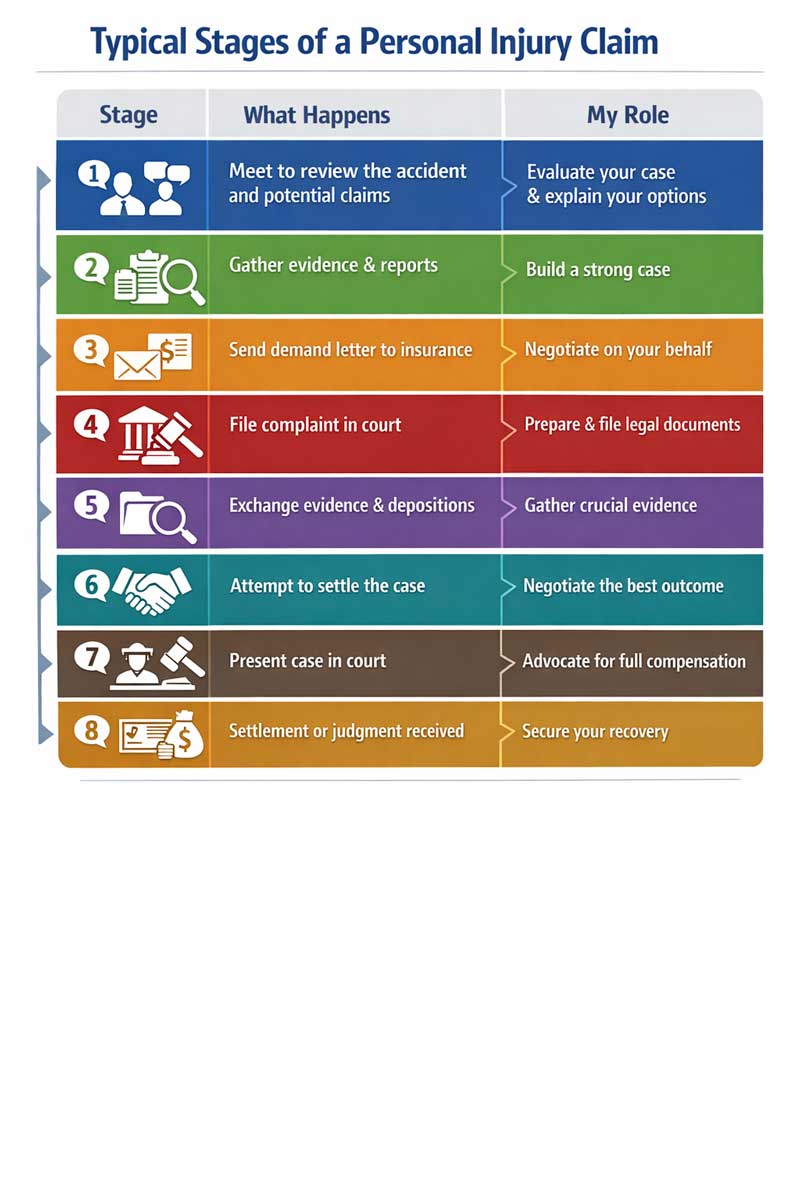
At Go2Attorney, We handle all settlement negotiations for our clients, because insurance companies often try to minimize payouts. Understanding the process helps you know what to expect and how your interests are protected.
Typical Settlement Negotiation Process
Case Evaluation
I review your medical records, bills, lost wages, accident reports, and other evidence to determine a realistic value for your claim.
Demand Letter
I send a formal demand letter to the at-fault party’s insurance company outlining your damages and requesting compensation.
This document sets the stage for negotiation and puts your claim on record.
Insurance Response
The insurer reviews your demand and may respond with:
Acceptance – agrees to your full demand
Counteroffer – proposes a lower settlement amount
Denial – disputes liability or damages
Negotiation Back and Forth
I negotiate strategically on your behalf, presenting additional evidence, explaining medical or financial impacts, and countering low offers.
This may involve multiple rounds of offers until a fair settlement is reached or litigation becomes necessary.
Settlement Agreement
Once we agree, I review the settlement document to ensure all your damages are covered, including medical liens and future care if needed.
You sign the agreement, and the insurance company issues payment.
At Go2Attorney, I work with clients whose claims are wrongly denied or undervalued by insurance companies. A denial does not mean you have no options—there are clear legal steps to challenge it and pursue compensation.
Steps After a Claim Denial
Request a Written Explanation
Insurance companies must provide a reason for denial. This is critical for evaluating your next steps.
Review and Gather Evidence
I carefully review medical records, accident reports, witness statements, and other documentation to identify gaps or errors in the insurer’s denial.
Submit an Appeal or Demand Letter
I prepare a formal appeal or renewed demand outlining why the claim should be paid, supported by evidence of your injuries, damages, and liability.
Negotiation or Mediation
Often, a revised negotiation or mediation with the insurer can resolve the claim without filing a lawsuit. I handle all communication to protect your rights.
Filing a Lawsuit if Needed
If the insurance company continues to deny the claim, I can file a personal injury lawsuit to seek compensation through the court system.
At Go2Attorney, I often get questions about whether a personal injury case can be reopened after a settlement. In most situations, once a case is fully settled and a release is signed, it cannot be reopened, but there are exceptions depending on the circumstances.
Key Considerations
Finality of Settlement
Settlements are typically binding contracts. Signing a release usually waives your right to pursue additional claims related to that accident.
Exceptions to Reopening
Fraud or misrepresentation – If the insurance company or other party hid key information that affected your decision.
Unknown injuries – If serious injuries were discovered after settlement and could not have been reasonably known at the time.
Breach of settlement terms – If the other party fails to comply with agreed payment terms.
Legal Process
Reopening a case usually requires filing a motion with the court or legal action based on the exception, which can be complex.
I review all documents and evidence to determine if there is a valid basis to challenge or reopen a settlement.
At Go2Attorney, I help clients understand how personal injury settlements are treated for tax purposes so there are no surprises after receiving compensation. In most cases, you will not owe federal income taxes on damages for physical injuries or illness, but some parts of a settlement may be taxable. See a tax professional.
Tax Treatment of Personal Injury Settlements
Non-Taxable Damages
Compensation for physical injuries, pain and suffering, medical bills, and emotional distress caused by a physical injury is generally not taxable. This includes reimbursement for medical treatment, lost wages from time off work due to injuries, and property damage directly tied to the injury.
Potentially Taxable Damages
Punitive damages (intended to punish the at-fault party) are usually taxable.
Interest earned on the settlement or portions allocated to lost wages or business income may also be subject to taxes.
Reporting and Documentation
Keep clear records of your settlement allocation (medical, lost wages, pain and suffering) to provide to the IRS if needed. I work with clients to ensure settlements are structured properly to maximize non-taxable components. But, See a tax professional..
At Go2Attorney, I help clients recover financial losses caused by an accident, including both lost wages and long-term impacts on earning potential. Florida law allows you to pursue these damages as part of a personal injury claim when the accident directly affects your ability to work.
Types of Economic Damages
Lost Wages
Compensation for income you missed while recovering from your injuries.
Includes salary, overtime, and bonuses if you can document your normal earnings.
Reduced Earning Capacity
If injuries limit your ability to perform your previous job or advance in your career, you may recover for future lost income or career opportunities.Expert testimony or vocational evaluations can help establish the financial impact.
Supporting Documentation
Pay stubs, tax returns, employer statements, and medical records all strengthen your claim for lost wages or earning capacity.
At Go2Attorney, I help clients plan for the full financial impact of injuries, including ongoing or future medical treatment. Personal injury claims in Florida can include compensation for both current medical costs and reasonably anticipated future care.
How Future Medical Care Is Handled
Assessment of Future Needs
I work with medical experts to determine the likely course of treatment, including surgeries, therapy, medications, assistive devices, and home care. This ensures your claim reflects the full extent of your medical needs.
Calculating Costs
Future medical expenses are estimated using current treatment costs, projected inflation, and anticipated frequency of care. These costs are included in your settlement demand or, if the case goes to trial, presented to the court as part of your damages.
Structured Settlements
In some cases, we can negotiate a structured settlement that provides regular payments for future care, ensuring funds are available when needed.
Medical Documentation
Keep thorough medical records, expert reports, and billing statements. I use these to demonstrate necessity and reasonableness to insurers or the court.
At Go2Attorney, I make sure my clients fully understand how medical bills, liens, and other expenses are handled when a personal injury case is resolved. Proper management of these costs ensures you receive the compensation you are entitled to.
Handling Liens and Medical Expenses
Medical Liens
Hospitals, doctors, and insurance companies sometimes place liens on your settlement to recover payments already made for your care. These liens must be paid before you receive your net settlement. I review each lien carefully to ensure they are valid and properly calculated.
Negotiating Reductions
Often, I can negotiate liens down with medical providers, insurers, or workers’ compensation carriers to maximize your take-home recovery.
Settlement Disbursement
Once the settlement is finalized, funds are used to:
Pay attorney fees and costs
Satisfy medical liens and bills
Distribute the remaining net proceeds to you
Documentation
I provide a detailed breakdown showing how your settlement is allocated, so you know exactly what you receive after all obligations are paid.
At Go2Attorney, I assist clients in recovering the value of damaged or totaled vehicles after a car accident. While I focus on the legal and claims side, I guide you through working with insurance companies to make sure your vehicle is properly repaired or replaced.
How Vehicle Claims Are Handled
Assessment of Damage
After an accident, your car may need an estimate from a certified auto repair shop or an appraisal if it’s totaled.
I help ensure the insurance company considers the full fair market value of your vehicle.
Repair or Replacement
If the car is repairable, the insurance company typically covers reasonable repair costs.
If your car is totaled, I make sure you receive replacement value based on comparable vehicles, not just the depreciated book value.
Negotiation with Insurers
Insurance companies sometimes undervalue vehicles. I handle all negotiations to maximize your recovery, whether for repairs, replacement, or rental coverage while your car is out of service.
Handling Claims Efficiently
I coordinate with your insurer, repair shops, and any third-party claims to ensure your car is addressed promptly, minimizing stress and downtime.