Serving Hillsborough
County for Over 20 Years
County for Over 20 Years

Welcome to Go2Attorney.com. I am W.F. “Casey” Ebsary Jr., and our firm is actively reviewing claims concerning the serious psychological and physical injuries suffered by children and teenagers due to social media use. Families across Florida and the nation are facing unprecedented crises involving severe depression, self-harm, eating disorders, and suicide attempts connected directly to algorithmic platform features. If your family is dealing with these devastating challenges, please know that you do not have to confront multi-billion-dollar tech corporations alone. I invite you to learn more about my background on my attorney biography page or reach out directly through our contact page for a confidential evaluation.
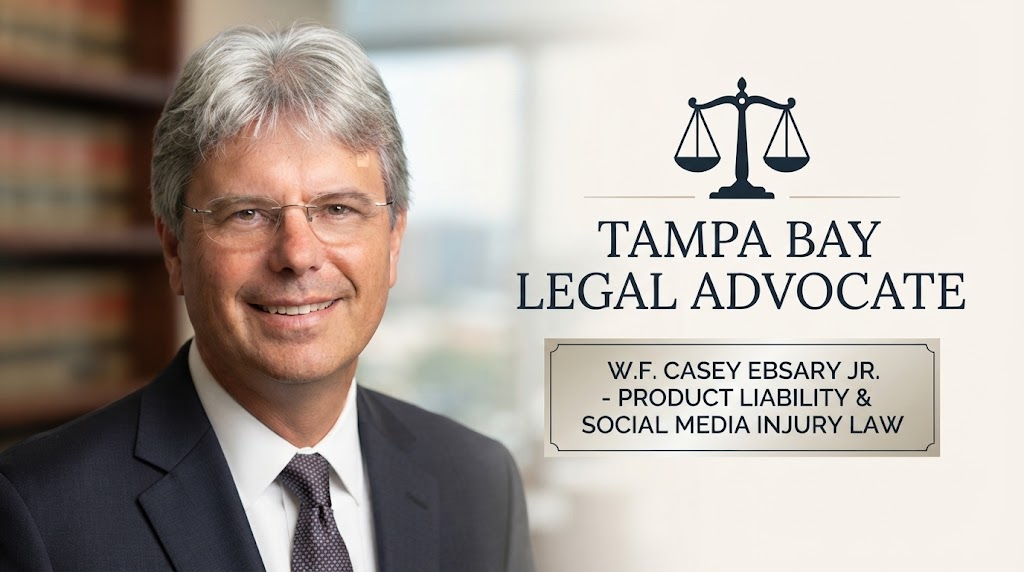
Operating from our Tampa office, we advocate for parents and families across the Tampa Bay area and throughout Florida whose children have suffered catastrophic mental health crises due to defective platform algorithms. While multidistrict litigation proceeds nationally, our firm provides localized, face-to-face counsel right here in Central Florida—evaluating claims, preserving digital evidence, and preparing cases under Florida personal injury law.
The lawsuits allege that major social media platforms intentionally engineered defective software designed to exploit adolescent brain development and foster compulsive, addictive engagement. Rather than treating these apps as mere conduits of third-party speech, these claims target specific product design choices, such as infinite scrolling, intermittent variable reward notifications, automated video playback, and algorithmic recommendation engines.
Plaintiffs assert that tech companies knew from their own internal research that these features promoted mental health decay among youth, yet withheld those warnings to maximize advertising revenues and daily active screentime. As a result, the legal theory is rooted primarily in traditional product liability, negligence, and failure-to-warn law rather than censorship of online content.
The primary corporate defendants named in the national litigation include Meta Platforms, Inc. (the operator of Instagram and Facebook), ByteDance Ltd. alongside TikTok Inc., Snap Inc. (the operator of Snapchat), and Alphabet Inc. alongside Google LLC (which operates YouTube). These entities are accused of utilizing algorithmic mechanics that actively trap minor users in harmful behavioral loops.
Each platform utilizes tailored feature sets, but all share the common thread of leveraging user data and biometric engagement markers to prolong exposure without reasonable parental controls. While other digital apps exist, current judicial proceedings are heavily focused on these major tech conglomerates.
Section 230 of the Communications Decency Act shields interactive computer services from civil liability when acting as the publisher or speaker of content provided by another user. In this litigation, courts—including the federal court overseeing consolidated proceedings—have drawn a crucial distinction between user-created third-party content and the platforms’ own defective, non-speech product design features.
Because plaintiffs are suing over features such as algorithmic feed architectures, deceptive notification cycles, and inadequate age verification safeguards, courts have held that Section 230 does not provide blanket immunity for defective design. By concentrating on the mechanics of the software itself rather than third-party text, photos, or videos, we are able to pursue legitimate product liability actions.
The Office of the U.S. Surgeon General has declared youth mental health an urgent public health crisis and specifically highlighted the risks associated with digital platforms. According to the Surgeon General’s Advisory on Social Media and Youth Mental Health, children and adolescents who spend more than three hours per day on social media face double the risk of experiencing serious mental health problems, including depression and anxiety.
The Advisory noted that nearly universal usage among adolescents occurs during critical phases of neurological development, making young brains uniquely vulnerable to compulsive reward feedback loops. Crucially, the Surgeon General concluded that there is insufficient evidence to show that current social media platforms are safe for children and teens.
When evaluating an inquiry, we look for intensive, compulsive platform usage that began while the individual was still a minor, typically between the ages of 10 and 17. Second, we look for a clear timeline demonstrating that the platform’s addictive design was a substantial contributing factor to the minor’s psychological deterioration. Third, the case must be supported by medical records, treatment facility logs, psychiatric assessments, or academic intervention documentation. Lastly, we evaluate the applicable statute of limitations to confirm the lawsuit is initiated within the strict timelines mandated by applicable law.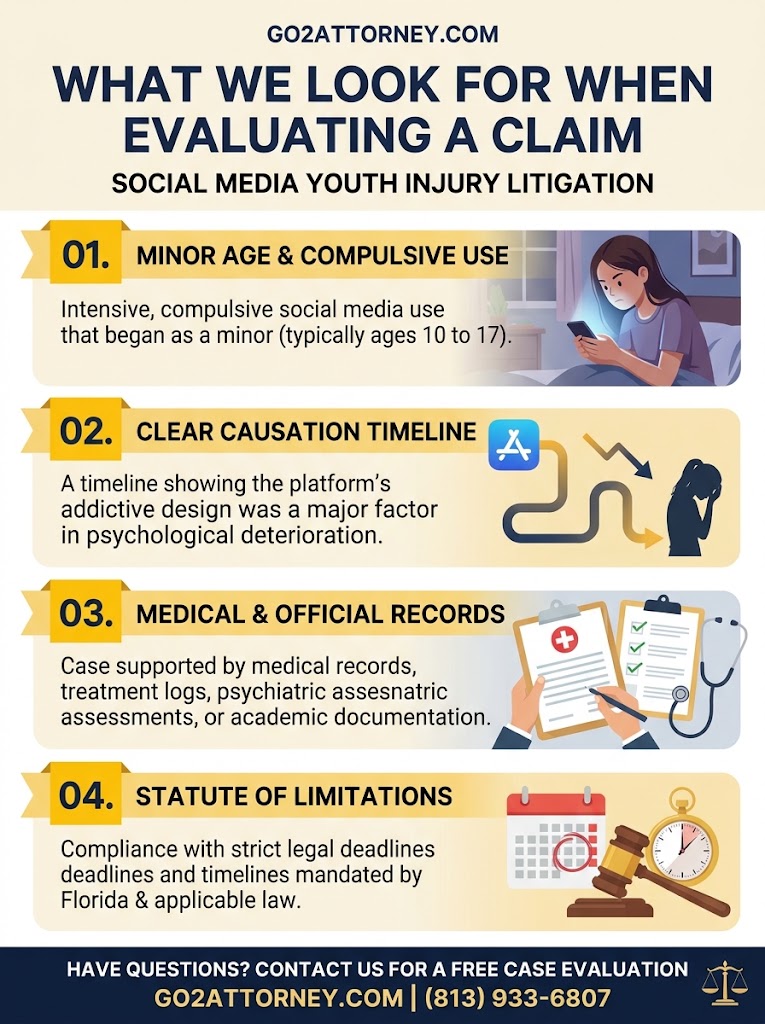
Plaintiffs in these actions seek compensatory damages to cover both past and future medical treatments associated with the platform-induced injuries. This includes reimbursement for emergency room visits, psychiatric hospitalizations, long-term prescription medication, and costly specialized residential treatment centers. Lawsuits also pursue compensation for severe emotional distress, pain and suffering, loss of educational attainment, and loss of life enjoyment. In tragic instances involving self-harm fatalities, surviving parents may seek wrongful death damages under applicable state statutory frameworks.
Under Florida personal injury law, strict statutes of limitations govern product liability actions against corporate tech developers. Whether your claim is coordinated directly into federal multidistrict proceedings or filed within the U.S. District Court for the Middle District of Florida (Tampa Division) or Hillsborough County Circuit Court, acting promptly is vital to preserve device logs and medical evidence.
The federal cases have been centralized into a multidistrict litigation known as In re: Social Media Adolescent Addiction/Personal Injury Products Liability Litigation, MDL No. 3047. This consolidated proceeding is pending in the United States District Court for the Northern District of California before Chief Judge Yvonne Gonzalez Rogers. Centralizing these claims allows a single federal judge to manage discovery, coordinate document disclosures, resolve common motions to dismiss, and oversee early bellwether trials. For up-to-date docket entries, federal filings, and official case management orders, public information can be reviewed directly via the United States District Court for the Northern District of California.
To maintain a viable product liability lawsuit, there must be demonstrable, physical or psychological harm formally diagnosed by a licensed medical provider. The recognized injuries in these actions include clinically diagnosed major depressive disorder, severe anxiety disorders, and dangerous eating disorders such as anorexia nervosa or bulimia. The claims also encompass documented self-harm incidents, severe sleep deprivation resulting in mental decompensation, and suicidal ideation, suicide attempts, or wrongful death. A claim generally cannot rest solely on generalized parental dissatisfaction or ordinary screen overuse; it requires formal medical intervention, residential therapy, inpatient psychiatric hospitalization, or catastrophic loss.
Under Florida law, strict deadlines govern when a civil lawsuit must be brought to avoid being permanently barred. Products liability actions and general personal injury claims founded on negligence must comply with the provisions set forth in Florida Statutes Section 95.11 on Justia. Under current Florida statutory standards, general negligence actions generally carry a two-year filing period, whereas certain product liability actions historically operated under a four-year framework depending on the underlying claim and discovery rules. Because determining the exact accrual date and tolling rules for minors involves complex legal scrutiny, you should contact our office immediately to avoid missing strict statutory cutoffs.
In an MDL proceeding, bellwether trials are representative sample cases selected by the court and litigants to be tried before a jury before hundreds of other cases go to trial. These initial trials serve as a testing ground for legal theories, scientific expert testimony, and jury reactions to the defendants’ conduct. The verdicts and outcomes of bellwether trials do not automatically bind every pending plaintiff, but they provide critical data that guides global settlement negotiations. If global settlements are not reached during the MDL phase, individual cases can eventually be remanded back to their home federal district courts for local trials.
Algorithmic engines are proprietary computer programs built by tech platforms to analyze every interaction, pause, scroll speed, and click made by a user. Instead of showing posts in chronological order, these algorithms deliberately push emotionally charged, polarizing, or dysmorphia-inducing content directly into a child’s feed to maximize time spent on the app. In court, we argue that this constitutes an active, defective product feature created directly by the tech companies rather than passive distribution of third-party information. When these engines repeatedly serve eating-disorder or self-harm content to an emotionally vulnerable minor, the company’s own programming directly contributes to the harm.
Yes, in many circumstances, young adults who suffered severe harm as minors may still have viable legal claims. While the injuries and compulsive use must have originated during their minority, applicable legal rules often toll or extend statutory deadlines depending on the age at which the injury manifested or was discovered. Because every jurisdiction enforces distinct statutory exceptions, tolling doctrines, and statutes of repose, analyzing your specific timeline with legal counsel is essential. We will examine the dates of first account creation, primary psychiatric intervention, and current age to determine eligibility.
Parents should preserve the electronic devices used by their child, including smartphones, tablets, and personal computers, ensuring that data is not deleted or wiped. You should retain screenshots of harmful algorithmic content, direct messages, warning notices, and account activity logs where possible. Additionally, gather all medical records, psychiatric evaluation notes, therapy receipts, hospital discharge summaries, and prescription logs. School records showing sudden drops in academic performance, disciplinary interventions, or attendance issues tied to nighttime social media use are also valuable pieces of corroborating evidence.
While litigation against Meta, ByteDance, Snap, and Alphabet spans federal dockets nationwide, our firm provides personal representation to families across:
To help families understand the scope of these actions, the following charts and tables synthesize the key legal components, defendant platforms, and clinical injuries currently under review in the litigation:
| Social Media Defendant | Major Platform(s) | Primary Engineered Features Challenged | Common Clinical Allegations |
| Meta Platforms, Inc. | Instagram, Facebook | Infinite scroll, algorithmic engagement loops, hidden likes, beauty filters | Anorexia, bulimia, severe depression, body dysmorphia |
| ByteDance Ltd. / TikTok Inc. | TikTok | “For You” feed predictive algorithms, continuous autoplay, intermittent alerts | Compulsive use, severe sleep disruption, self-harm trends |
| Snap Inc. | Snapchat | Vanishing messages, streaks mechanics, continuous geolocational pressure | Extreme anxiety, self-harm, peer validation compulsions |
| Alphabet Inc. / Google LLC | YouTube | Algorithmic autoplay, tailored behavioral recommendations, short-form feed | Dopamine loop addiction, isolation, major depressive disorder |