Serving Hillsborough
County for Over 20 Years
County for Over 20 Years


A major maritime negligence boat lawsuit has been filed in the Pinellas County Circuit Court following a two-vessel collision near the Memorial Causeway Bridge in Clearwater, Florida. The legal action stems from an incident on April 27, 2025, at approximately 8:00 p.m., involving a commercial ferry and a private recreational vessel. According to the filed complaint, passengers on board a Clearwater Ferry Services vessel were injured when the ferry collided with a 37-foot recreational boat.
The lawsuit alleges that the private watercraft was being operated at an excessive speed for the prevailing conditions and that the operator failed to take proper evasive action to avoid the crash. The lawsuit brings forward six distinct counts seeking damages in excess of $50,000. These include negligence against the ferry company, alleging that the commercial operators failed in their duty to safely navigate and protect their business invitees. It also alleges negligence against the recreational boat operator for reckless operation and failure to maintain a proper lookout or safe speed. Finally, the suit brings vicarious liability against the boat owner, seeking to hold the corporate owner of the 37-foot vessel financially responsible for allowing the operator to use the watercraft.
The plaintiffs involved report sustaining severe, continuing, and permanent bodily injuries from the impact, and a jury trial has been demanded to resolve the matter.
I am W.F. “Casey” Ebsary Jr., a Florida Bar Board Certified Criminal Trial Lawyer and former prosecutor practicing in the Tampa Bay area. If you or a loved one has been injured on the water, you need an experienced trial advocate who will handle your case directly without passing you off to an assistant or a case manager. I have spent my career representing injured individuals—never the insurance corporations. Please contact my office today at 813-222-2220, or visit our secure Contact Us Page to schedule your free consultation. You can also learn more about my background, education, and credentials by visiting my official Attorney Bio Page.


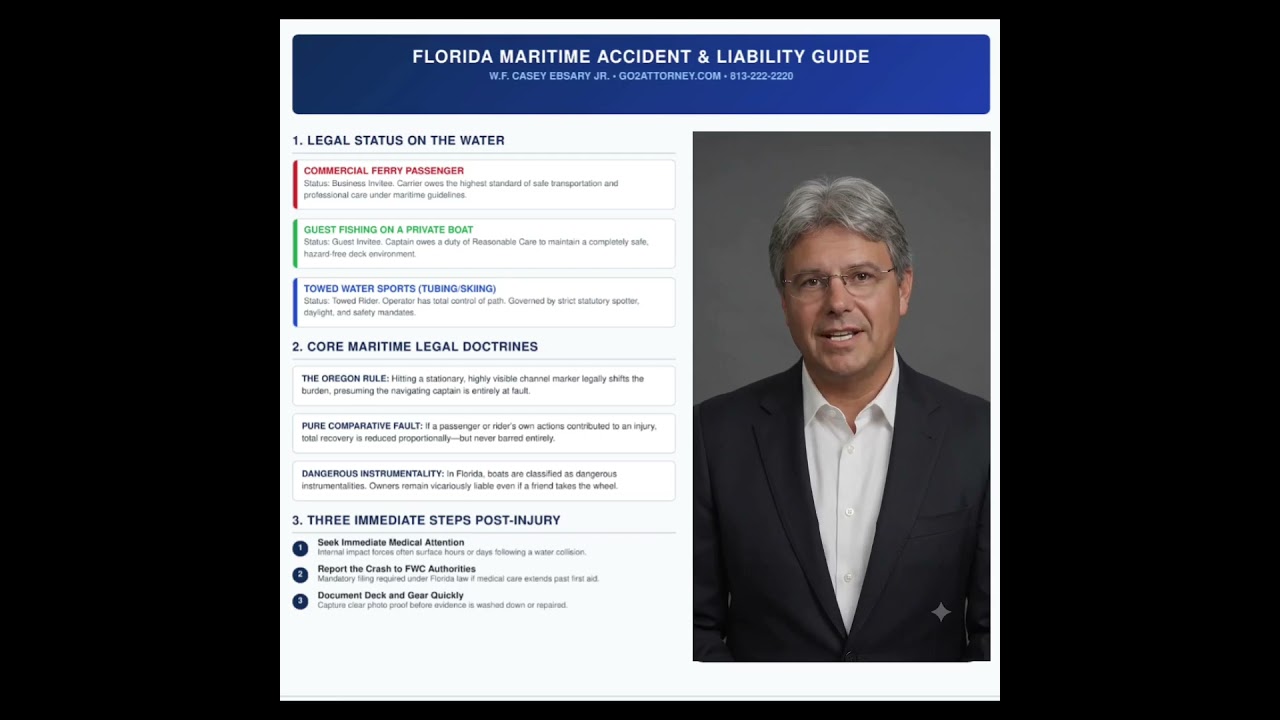
Answer: When you pay a fare to board a commercial watercraft in Florida, the law classifies you as a business invitee. This legal status means that the vessel operators and the commercial company owe you a high standard of safe transportation and vigilant care. If they fail to safely navigate the vessel, ignore prevailing weather conditions, or fail to protect you from preventable onboard hazards, they can be held directly liable for your medical bills and personal suffering.
Answer: As a social guest on a private vessel, your legal protections are governed by the standard of reasonable care under the circumstances. The operating captain has a strict legal obligation to maintain a safe, non-slip deck environment and keep a sharp lookout for surrounding hazards or oncoming boats. If the operator acts recklessly, speeds through a designated wake zone, or drives under the influence, you have the right to pursue a negligence claim against them for your losses.
Answer: Towed water sports are heavily regulated under Florida statutes because the vessel operator has absolute control over your speed, stability, and direction. The driver must always utilize a qualified observer or a wide-angle rearview mirror to monitor your physical safety at all times. When a driver accelerates excessively, performs reckless maneuvers, or operates after dark, their violation of state safety laws provides a strong foundation for an injury claim.
| Liability Scenario / Victim Status | Primary Target of Liability | Substantive Legal Basis |
| Guest Fishing on a Private Boat | The Boat Operator or Owner | General negligence; breach of the duty to maintain a safe environment and proper lookout. |
| Someone Being Towed (Skiing/Tubing) | The Towing Vessel’s Operator | Statutory violations, causing dangerous whip effects, or reckless vessel maneuvers. |
| Passenger on a Hired/Commercial Ferry | Commercial Operator & Owner | Failing to safely navigate, dangerous vessel operation, or breach of common carrier duty to business invitees. |
| Passenger Struck by Fixed Object | The Operating Captain | The Oregon Rule presumption of fault for colliding with a highly visible, stationary navigation marker. |
Answer: The Oregon Rule is a powerful maritime doctrine establishing that when a moving vessel hits a stationary, fixed object, the moving vessel is legally presumed to be at fault. This means that if a captain crashes into a highly visible channel marker, a bridge piling, or a properly anchored boat, the legal burden shifts directly onto that captain to prove they were not negligent. For an injured passenger, this presumption significantly strengthens your claim right from the start of the litigation.
Answer: Yes, a boat owner can absolutely be held financially accountable even if they were miles away or sitting quietly as a passenger when the crash occurred. Under Florida common law, a motorized watercraft is classified as a dangerous instrumentality, which places a heavy legal responsibility on the person who holds the title. This means that if an owner gives express or implied permission to a friend, family member, or corporate employee to operate the boat, the owner is vicariously liable for any injuries caused by that driver’s negligence.
Answer: Florida utilizes a comparative negligence system, meaning that fault can be shared among multiple parties involved in a single watercraft accident. If an insurance company or a jury determines that your own actions contributed to your injuries, your final financial compensation will be reduced by your exact percentage of blame. Fortunately, being partially at fault does not bar your lawsuit entirely, and we will work tirelessly to minimize your exposure while maximizing the accountability of the reckless driver.
Answer: Your absolute first priority must be to seek a comprehensive medical evaluation, because the extreme internal forces of a boat impact can cause severe trauma that may not fully manifest for several days. After addressing your physical health, you must ensure that the incident is officially reported to the Florida Fish and Wildlife Conservation Commission or local marine law enforcement. Finally, you need to preserve every piece of physical evidence available, including your passenger tickets, medical receipts, and timestamped photographs of the vessel damage.
Answer: We aggressively pursue full compensation for the entire spectrum of your financial, physical, and emotional losses. This includes securing funds for your current emergency room bills, ongoing physical therapy, lost wages, and any long-term reduction in your future capacity to earn a living. Furthermore, we demand significant compensation for your physical pain, ongoing suffering, permanent disfigurement, and the overall loss of your capacity to enjoy daily life.
Answer: Corporate insurance adjusters are highly trained professionals whose primary objective is to minimize or completely deny your claim to protect their company’s profits. They will frequently attempt to record your conversations, twist your statements, and use your own words against you to assign comparative fault. By retaining my firm immediately, you establish a protective barrier, ensuring that all communications go directly through an experienced trial attorney who knows how to counter their tactics.
To ensure you have access to verified factual data, you can review the official regulations, reporting standards, and statutory codes governing Florida maritime activities:
Review the official safe boating guidelines and accident reporting rules provided by the Florida Fish and Wildlife Conservation Commission.
Examine the federal maritime safety mandates and commercial vessel enforcement guidelines via the United States Coast Guard.
Read the exact language of Florida’s vessel regulations and navigation penalties listed under Florida Statutes Chapter 327 on Justia.
Look up the statutory requirements regarding operator duties and equipment compliance under Florida Statutes Chapter 328 on Justia.
Do not try to face powerful insurance corporations or complex maritime legal systems on your own. I am ready to stand by your side, handle all the heavy legal lifting, and fight for the maximum compensation you deserve. Call my office today at 813-222-2220 to speak with me directly, or fill out our secure form on our Contact Us Page to launch your case review.