- Free Consultation: (813) 933-6807 Tap Here To Call Us


TVPRA Claims – Trafficking Victims Protection Reauthorization Act



Core Elements TVPRA Claims: Questions & Answers with W.F. “Casey” Ebsary
TVPRA Claims – I am W.F. “Casey” Ebsary, a board-certified criminal trial lawyer and former prosecutor with more than 30 years of experience. In my practice at go2attorney.com, I represent individuals and families navigating complex and sensitive cases, including those involving human trafficking.
While many discussions focus on claims against hotels, the reality is that the Trafficking Victims Protection Reauthorization Act (TVPRA) extends far beyond a single industry. In my experience, trafficking cases often involve networks of individuals and entities—some obvious, others less so. The law allows victims to pursue civil claims against those who played a role in the exploitation, provided the legal elements can be established.
I do not assume liability, and I do not expand claims beyond what the evidence supports. But when the facts justify it, I carefully examine all potential avenues for accountability. This page provides a detailed, evidence-based explanation of where and how those claims may arise.
What are the core elements of TVPRA Claims?
A civil claim under the TVPRA generally requires proof that a defendant knowingly benefited from participation in a venture engaged in trafficking activity. The statute, found at 18 U.S.C. § 1595, provides victims with a private right of action.
From my perspective, every case turns on three essential elements: benefit, participation, and knowledge. These are not abstract concepts—they must be supported by real, admissible evidence. Courts typically define a “venture” as an association of individuals or entities working together, whether formally or informally.
To succeed, we must show that the defendant either knew or should have known that the venture was engaged in trafficking. If any one of these elements is missing, the claim may not survive. I approach these elements methodically because federal courts expect precision, not speculation.
Beyond hotels, what other entities may be examined in TVPRA claims?
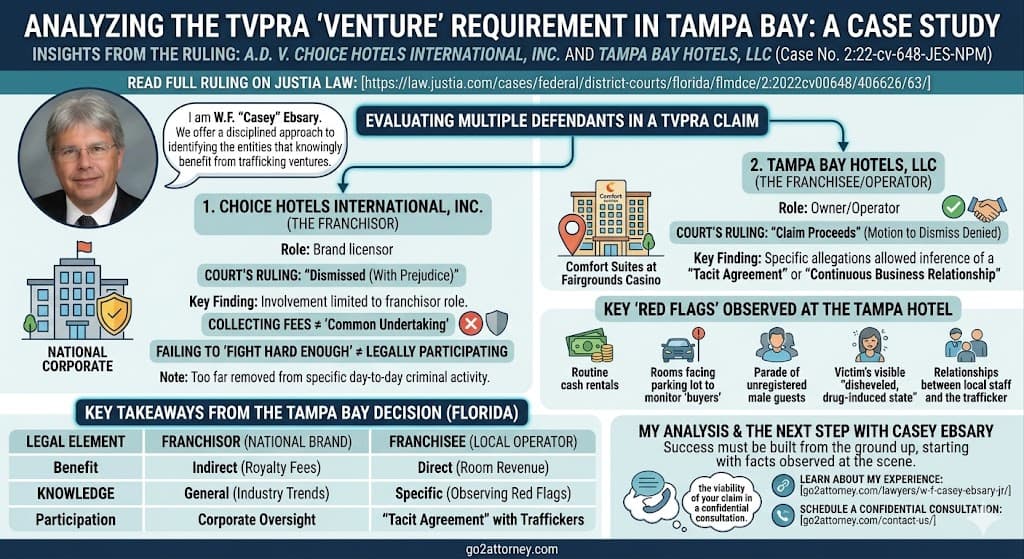
Although hotels are frequently discussed, they are only one piece of a much larger picture. Depending on the facts, other entities may include transportation providers, landlords, staffing agencies, and online platforms.
The TVPRA is intentionally broad, but it is not limitless. The central question is always the same: did the entity knowingly benefit from participation in a trafficking venture? That inquiry requires a deep examination of operations, policies, and what employees or agents observed.
Every case is different. A labor trafficking case involving agricultural workers may look very different from a sex trafficking case involving hotels. I focus on evidence—not assumptions—when identifying potential defendants.
Can landlords or property owners be held accountable for TVPRA Claims?
Yes, in certain circumstances. When trafficking occurs on property controlled by a landlord, I examine whether the owner had actual or constructive knowledge and whether their conduct could be viewed as participation in a venture.
This often involves looking for patterns—repeated police visits, persistent complaints, or obvious signs of illegal activity. In some cases, the issue becomes whether the landlord engaged in “willful blindness,” choosing to ignore clear warning signs to continue receiving financial benefits.
However, I do not assume liability simply because criminal activity occurred on a property. The law requires a direct connection between the landlord’s conduct and the trafficking venture. If that connection is not supported by evidence, I will not pursue the claim.
What about transportation providers?
Transportation can play a role in trafficking operations, particularly when victims are moved between locations. In some cases, I evaluate whether a transportation provider’s conduct goes beyond routine service.
This is a challenging area. Providing transportation alone is generally not enough. I must identify “something more” that links the conduct to participation in a trafficking venture. That could include repeated conduct, facilitation, or ignoring clear warning signs.
Courts are cautious in this area, especially with common carriers. If I cannot establish knowledge and participation with credible evidence, I will not move forward.
Can online platforms or digital services be involved?
This is one of the most complex and evolving areas of law. In some cases, online platforms may be examined if they are alleged to have facilitated trafficking activity.
However, I am careful not to overstate what the law allows. There are significant legal defenses and statutory protections that may apply. Any claim involving a digital platform requires detailed legal and technical analysis.
If I am not confident that a claim is viable under current law, I will say so. I do not pursue speculative or untested claims without a solid legal foundation.
Can employers or staffing agencies be liable for TVPRA Claims?
In labor trafficking cases, I may evaluate TVPRA Claims whether employers or staffing agencies contributed to exploitation. This can include examining recruitment practices, wage arrangements, and working conditions.
For example, evidence of coercion, debt arrangements, or document control may be relevant. However, I do not assume liability based solely on an employment relationship. The same three elements—benefit, participation, and knowledge—must be established.
If those elements are not supported by evidence, I will not pursue a claim.
Comparative Analysis of Potential Defendants
| Entity Type | Potential Benefit | Common Indicators of Knowledge |
|---|---|---|
| Hotels | Room revenue, fees | Repeated complaints, unusual traffic patterns |
| Landlords | Rent payments | Police activity, tenant reports |
| Staffing Agencies | Placement fees | Reports of coercion or unsafe conditions |
| Digital Platforms | Advertising revenue | Repeated flagged content or reports |
This table is not a checklist. It is a framework I use to evaluate whether the facts support further investigation.
What types of evidence are important when expanding beyond hotels?
When evaluating additional defendants, I focus on evidence that ties the entity directly to the core elements of a TVPRA claim.
Evidence Considerations
| Evidence Type | Why It Matters |
|---|---|
| Financial records | May show benefit from the activity |
| Communications | Can indicate knowledge or awareness |
| Internal policies | May reveal failure to address risks |
| Prior complaints | Show repeated warning signs |
| Operational conduct | May demonstrate participation |
I do not rely on isolated facts. I evaluate whether the totality of the evidence supports a legally viable claim.
How do I determine whether to include multiple defendants?
Including multiple defendants can increase both the complexity and cost of litigation. I do not add parties without a clear legal basis.
My approach is to evaluate each potential defendant individually. If the evidence supports the required elements and can withstand legal scrutiny, I consider including that party. If not, I do not.
This disciplined approach helps maintain credibility and strengthens the overall case.
Are there risks in pursuing broader claims?
Yes. Expanding a case can increase costs, delay resolution, and introduce additional legal challenges. Defendants may also shift blame among themselves, complicating the case further.
I discuss these risks openly with my clients. My goal is not to pursue the largest case possible, but the strongest one supported by evidence.
Can state law claims still apply alongside TVPRA claims?
Yes. In addition to federal claims, state law claims such as negligence or premises liability may apply.
However, I do not assume these claims are always available or beneficial. State laws vary, and some may impose shorter deadlines or different standards. Each case requires a careful evaluation of applicable law.
How do courts evaluate “knowledge” across different industries?
Constructive knowledge—what a defendant should have known—is evaluated based on the specific context. What counts as a “red flag” in one industry may not apply in another.
Courts often look at whether the defendant ignored obvious warning signs. However, those signs vary depending on the nature of the business. I tailor each case to the specific industry involved.
What damages may be available?
Under federal law, victims may seek compensatory damages and, in some cases, punitive damages. Attorney’s fees may also be recoverable.
I do not promise outcomes. The availability and amount of damages depend on the evidence and how the law is applied.
Frequently Asked Questions
Can I pursue multiple defendants at once?
Yes, if the evidence supports claims against each one. I do not include parties without a solid legal basis.
What if I am unsure who was involved?
That is common. I can investigate and help identify potential defendants, but I do not make claims without evidence.
Does adding more defendants increase the value of a case?
Not necessarily. The strength of the evidence matters more than the number of defendants.
How do I know if my case is strong?
That requires a detailed review of the facts. I evaluate each case carefully before offering an opinion.
Take the Next Step

Learn more about my trial experience:
https://www.go2attorney.com/lawyers/w-f-casey-ebsary-jr/
Schedule a confidential consultation:
https://www.go2attorney.com/contact-us/
Final Thoughton TVPRA Claims
TVPRA claims extend beyond any single industry, but they are not unlimited. Every claim must be grounded in evidence and supported by law.
I do not speculate, and I do not overreach. If I do not know the answer, I will say so. What I offer is a disciplined, evidence-based approach to identifying and pursuing accountability where the law supports it.
W.F. “Casey” Ebsary Jr.
Board-Certified Criminal Trial Lawyer
go2attorney.com
FULL TEXT OF TVPRA CLAIMS ORDER
https://law.justia.com/cases/federal/district-courts/florida/flmdce/2:2022cv00648/406626/63
UNITED STATES DISTRICT COURT MIDDLE DISTRICT OF FLORIDA FORT MYERS DIVISION A.D., an individual, Plaintiff, v. CHOICE HOTELS INTERNATIONAL, INC. and TAMPA BAY HOTELS, LLC, Defendants. Case No: 2:22-cv-648-JES-NPM OPINION AND ORDER This matter comes before the Court on review of defendant Tampa Bay Hotels, LLC Motion to Dismiss Plaintiffs’ Second Amended Complaint, or in the Alternative, Motion to Strike (Doc. #50) filed on May 23, 2023, and defendant Choice Hotels International, Inc.’s Motion to Dismiss Plaintiff’s Second Amended Complaint (Doc. #51) filed on June 1, 2023. Plaintiff filed a Consolidated Response in Opposition (Doc. #56) on July 3, 2023. Both defendants filed Replies. (Docs. ## 60, 61.) Plaintiff filed a Notice of Supplemental Authority (Doc. #62) on August 8, 2023. I. On April 19, 2023, the Court granted in part defendants’ motions to dismiss with leave to file an Amended Complaint. A.D. v. Choice Hotels Int’l, Inc., No. 2:22-CV-648-JES-NPM, 2023 WL 3004547, at *1 (M.D. Fla. Apr. 19, 2023). On May 9, 2023, plaintiff filed a Second Amended Complaint (Doc. #46) and defendants have now essentially renewed their motions to dismiss. Under Federal Rule of Civil Procedure 8(a)(2), a Complaint must contain a “short and plain statement of the claim showing that the pleader is entitled to relief.” Fed. R. Civ. P. 8(a)(2). This obligation “requires more than labels and conclusions, and a formulaic recitation of the elements of a cause of action will not do.” Bell Atl. Corp. v. Twombly, 550 U.S. 544, 555 (2007) (citation omitted). In deciding a Rule 12(b)(6) motion to dismiss, the Court must accept all factual allegations in a complaint as true and take them in the light most favorable to plaintiff, Erickson v. Pardus, 551 U.S. 89 (2007), but “[l]egal conclusions without adequate factual support are entitled to no assumption of truth,” Mamani v. Berzain, 654 F.3d 1148, 1153 (11th Cir. 2011) (citations omitted). Plaintiff’s (second) amended complaint is brought pursuant to the Trafficking Victims Protection Reauthorization Act (TVPRA). As previously stated, The TVPRA is a criminal statute that also provides a civil remedy to victims of sex trafficking. Section 1591(a) of the Act imposes criminal liability for certain sex trafficking: (a) Whoever knowingly– (1) in or affecting interstate or foreign commerce, or within the special maritime and 2 territorial jurisdiction of the United States, recruits, entices, harbors, transports, provides, obtains, advertises, maintains, patronizes, or solicits by any means a person; or (2) benefits, financially or by receiving anything of value, from participation in a venture which has engaged in an act described in violation of paragraph (1), knowing, or, except where the act constituting the violation of paragraph (1) is advertising, in reckless disregard of the fact, that means of force, threats of force, fraud, coercion described in subsection (e)(2), or any combination of such means will be used to cause the person to engage in a commercial sex act, or that the person has not attained the age of 18 years and will be caused to engage in a commercial sex act, shall be punished as provided in subsection (b). 18 U.S.C.A. § 1591(a). In addition to a criminal punishment, the TVPRA provides the following civil remedy: (a) An individual who is a victim of a violation of this chapter may bring a civil action against the perpetrator (or whoever knowingly benefits, financially or by receiving anything of value from participation in a venture which that person knew or should have known has engaged in an act in violation of this chapter) in an appropriate district court of the United States and may recover damages and reasonable attorneys fees. 18 U.S.C. § 1595(a). Thus, the TVRPA authorizes a victim of sex trafficking to bring a direct civil claim against the perpetrator of the trafficking and a “beneficiary” civil claim against “whoever knowingly benefits, financially or by receiving anything of value from participation in a venture which that person knew or should 3 have known has engaged in an act in violation of [the TVPRA].” 18 U.S.C. § 1595(a). To state a claim for beneficiary liability under the TVPRA, Plaintiff must plausibly allege that the defendant “(1) knowingly benefited (2) from participating in a venture; (3) that venture violated the TVPRA as to [A.D.]; and (4) [Defendants] knew or should have known that the venture violated the TVPRA as to [A.D.].” Doe v. Red Roof Inns, Inc., 21 F.4th 714, 726 (11th Cir. 2021). A.D. v. Choice Hotels Int’l, Inc., at *2. The Court will consider each of the elements as applied to the amended pleading. II. The operative amended complaint alleges the following: Defendant Choice Hotels International, Inc. (Choice Hotels) knows and has known for years that sex trafficking and prostitution occur at their branded hotel locations. Defendant Tampa Bay Hotels, LLC (Tampa Bay) also knows and has known for years of both occurring specifically at the Comfort Suites at Fairgrounds Casino (Comfort Suites) located in Tampa, Florida. (Doc. #46, ¶¶ 2-3.) This action for damages is brought by the Plaintiff, identified by her initials A.D., a survivor of sex trafficking under the TVPRA. (Id. at ¶ 12.) “With knowledge of the problem, and as a direct and proximate result of Defendants’ multiple failures and refusals to act, mandate, establish, execute, and/or modify their anti-trafficking efforts at the Comfort Suites hotel, A.D. was continuously sex 4 trafficked, sexually exploited, and victimized repeatedly at the Comfort Suites hotel.” (Id. at ¶ 18.) Plaintiff alleges that defendants “participated in a hotel operating venture and knowingly benefited from this venture through room rentals, profits, third party fees, and the value of the “good will” of the Choice® brand. The venture knew or should have known that they were profiting from sex trafficking, including the sex trafficking of A.D., in violation of the TVPRA.” (Id. at ¶ 19.) Plaintiff further alleges that Choice Hotels and Tampa Bay participated in a hotel operating venture that included staff at the Comfort Suites. Tampa Bay owns the Comfort Suites pursuant to a franchise agreement entered into with Choice Hotels. Plaintiff alleges an agency relationship through Choice Hotels’ “exercise of ongoing and systemic right of control over the Comfort Suites hotel.” (Id. at ¶¶ 29-32.) Choice Hotels makes decisions that directly impact the operations and maintenance of their branded hotels, including the Comfort Suites. (Id. at ¶ 39.) Tampa Bay directly offered public lodging services at the Comfort Suites where A.D. was trafficked for sex. (Id. at ¶ 49.) Defendants “participated in a hotel operating venture in connection with the management and operating of the Comfort Suites hotel involving risk and potential profit.” (Id. at ¶ 52.) 5 During at least 2008 to 2012, emails were exchanged by employees of Choice Hotels that related to sex trafficking in hotels, including the Comfort Suites. (Id. at ¶ 57.) Choice Hotels had actual and/or constructive knowledge of sex trafficking, including A.D.’s sex trafficking and victimization, occurring on its branded property. (Id. at ¶ 63.) Choice Hotels continued to permit and profit from male clientele who rented hotel rooms to buy sex despite having access to sex trafficking indicators. (Id. at ¶ 75.) Defendants “had actual or constructive knowledge of law enforcement activity at the Comfort Suites hotel reporting sexual battery, drug dealing and other illicit activities occurring at the hotel.” (Id. at ¶ 87.) Tampa Bay employees and staff openly observed signs of trafficking and did not aid plaintiff. Tampa Bay received revenue and a percentage was provided to Choice Hotels. (Id. at ¶ 104.) Through Choice Hotels’ relationship with the staff at the Comfort Suites, it benefited or received royalty payments, licensing fees, membership fees and dues, reservation fees, and percentages of the gross room revenue. (Id. at ¶ 105.) Through their “continuous business venture of renting hotel rooms”, Tampa Bay knowingly benefited. (Id. at ¶ 107.) Plaintiff alleges that defendants benefit from the steady stream of income that sex traffickers bring to their hotel brands and from their reputation for privacy, 6 discretion, and the facilitation of commercial sex. (Id., ¶¶ 116117.) III. As previously stated, plaintiff must sufficiently plead that a defendant knowingly benefited from participating in a venture, that the venture violated the TVPRA, and that defendants knew or should have known that the venture violated the TVPRA. A. Knowingly Benefited To satisfy the first element of a TVPRA beneficiary claim, plaintiff must allege that defendant “knew it was receiving some value from participating in the alleged venture.” Red Roof Inns, 21 F.4th at 724. As the Eleventh Circuit stated, “Knowingly benefits” means “an awareness or understanding of a fact or circumstance; a state of mind in which a person has no substantial doubt about the existence of a fact.” Knowledge, Black’s Law Dictionary (11th ed. 2019). And Section 1595(a) explains that a defendant may benefit “financially or by receiving anything of value.” Accordingly, a plaintiff like the Does must allege that the defendant knew it was receiving some value from participating in the alleged venture. Id. at 723–24. In the absence of a more stringent statutory pleading requirement, knowledge “may be alleged generally.” Fed. R. Civ. P. 9(b). Alleging a “continuous business relationship” is sufficient to show a knowing benefit. G.G. v. Salesforce.com, Inc., No. 22-2621, 2023 WL 4944015, at *16 (7th Cir. Aug. 3, 2023). 7 The Court previously found this element could be satisfied at this stage of the proceedings. A.D. v. Choice Hotels Int’l, Inc., at *3. B. Participation in Venture – Franchisor Plaintiff must allege that the benefits received by Choice Hotels were from “participation in a venture” which defendants knew or should have known has engaged in an act in violation of the TVPRA. 18 U.S.C. § 1595(a). The Eleventh Circuit rejected the statutory definition of “participation in a venture” found in the criminal provision, § 1591(e)(4), which defined “participation in a venture” as “knowingly assisting, supporting or facilitating a violation of subsection (a)(1).” Instead, the Eleventh Circuit held that “participation in a venture” in the civil context requires that plaintiff allege that the franchisor “took part in a common undertaking or enterprise involving risk and potential profit.” Red Roof Inns, 21 F.4th at 725. Plaintiff alleges that defendants “participated in a hotel operating venture and knowingly benefited from this venture through room rentals, profits, third party fees, and the value of the “good will” of the Choice® brand. The venture knew or should have known that they were profiting from sex trafficking, including the sex trafficking of A.D., in violation of the TVPRA.” (Doc. #46, ¶ 19.) Plaintiff alleges that defendants “participated in a 8 hotel operating venture” in connection with the Comfort Suites for potential profit. (Id. at ¶ 52.) Plaintiff alleges that Choice Hotels “had actual and/or constructive knowledge of sex trafficking, including A.D.’s sex trafficking and victimization,” at its branded property and it “failed to implement and enforce any of its own policy or policies and protect Plaintiff A.D. from being sex trafficked”, failed to take action to prevent trafficking so that it could continue to profit, and failed to address the open and obvious presence of human trafficking on hotel properties. (Id. at ¶ 63.) Choice Hotels is alleged to have demonstrated actual and/or constructive knowledge of the “rampant culture of sex trafficking” at their properties around the country, including through news stories and online reviews. (Id. at ¶ 78.) These additional facts in the Second Amended Complaint do not remedy the problem in the original pleading as to Choice Hotels. “[A]s the Eleventh Circuit has acknowledged, the alleged venture can be a ‘commercial venture’ like running or expanding a business. G.G. v. Salesforce.com, Inc., No. 22-2621, 2023 WL 4944015, at *6 (7th Cir. Aug. 3, 2023) (citing Red Roof Inns, Inc., 21 F.4th at 727 (emphasis added)). However, as before, “[t]he ‘participation’ in the sex trafficking venture is essentially that the franchisor and the hotel operator did not fight hard enough to keep these traffickers from using their hotel. The Complaint acknowledges 9 that Defendants opposed sex traffickers, but fault defendants for taking ineffective steps to curtail the traffickers. This hardly sounds like participating in a venture.” A.D. v. Choice Hotels Int’l, Inc., at *4. The Court finds that Choice Hotels must be dismissed because the Second Amended Complaint does not sufficiently plead that it participated in a sex trafficking venture beyond participation in shared revenue as part of its normal role as a franchisor. Red Roof Inns, Inc., 21 F.4th at 726–27 (“These allegations may suggest that the franchisors financially benefitted from renting hotel rooms to the Does’ sex traffickers. But they do nothing to show that the franchisors participated in a common undertaking involving risk or profit that violated the TVPRA—i.e., the alleged sex trafficking ventures.”). C. Participation in Venture – Franchisee “In order to plead Defendants participated in a venture, Plaintiff must allege facts from which the Court could reasonably infer the hotels ‘could be said to have a tacit agreement’ with the trafficker. Plaintiff need not show that defendants had actual knowledge of the participation in the sex-trafficking venture.” Doe v. Rickey Patel, LLC, No. 0:20-60683-WPD-CIV, 2020 WL 6121939, at *5 (S.D. Fla. Sept. 30, 2020) (citation omitted). In other words, plaintiff can show a “continuous business relationship” to 10 show participation. J.G. v. Northbrook Indus., Inc., 619 F. Supp. 3d 1228, 1235 (N.D. Ga. 2022); S.Y. v. Wyndham Hotels & Resorts, Inc., 519 F. Supp. 3d 1069, 1081 (M.D. Fla. 2021). As to Tampa Bay, the ‘participation’ is based upon the relationship between the traffickers and the hotel. Trafficker 2 routinely instructed A.D. to rent multiple rooms in her name using cash with one room facing the parking lot to monitor when buyers would arrive. There would be “a parade of unregistered male guests coming in and out of the hotel room at all times of day.” (Doc. #46, ¶¶ 95-96.) “The rooms were rented by night and the next morning A.D. in her disheveled, drug induced state, would go to the front desk and extend the stay.” (Id. at ¶ 97a.) Other red flags include excessive requests for sheets, a personal relationship between staff and the trafficker, and direct employee encounters. (Id. at ¶ 97j-l.) These facts at least plausibly infer that employees of the Comfort Suites were participating in an enterprise involving risk and knowingly benefiting from the risk. Red Roof Inns, Inc., 21 F.4th at 725 (citing Ricchio v. McLean, 853 F.3d 553, 556-58 (1st Cir. 2017) (agreeing with First Circuit that an operator’s association with traffickers to serve a business objective establishes participation in a venture with a sex trafficker). 11 D. Knowledge This element requires the plaintiff to allege that the defendant had either actual or constructive knowledge that the venture violated the TVPRA as to the plaintiff. Red Roof Inns, 21 F.4th at 725. Knowledge requires an awareness or understanding of a fact or circumstance, while constructive knowledge is knowledge that one should have ‘using reasonable care or diligence’. Id. (citing Black’s Law Dictionary). The ‘red flags’ supporting knowledge include payments in cash, large amounts of used condoms and bodily fluids on the sheets and towels, A.D.’s physical appearance, excessive requests for sheets and cleaning services, the personal relationship with staff and A.D.’s trafficker, and the direct employee encounters with A.D. and her trafficker inside the Comfort Suites. (Doc. #46, ¶ 99.) Tampa Bay employees and staff openly observed signs of trafficking and did not aid plaintiff. (Id. at ¶ 104.) The Court finds these facts are sufficient to plausibly allege knowledge at this stage of the proceedings. An overt or direct act is not required. See, e.g., K.H. v. Riti, Inc., No. 1:22-CV3404-MHC, 2023 WL 3644224, at *4 (N.D. Ga. Apr. 17, 2023) (collecting cases of direct association between hotel and trafficker); J.C. v. I Shri Khodiyar, LLC, 624 F. Supp. 3d 1307, 1318 (N.D. Ga. 2022) (Plaintiff claims that her daughter was forced 12 to have sex with Defendant’s employees); J.G. v. Northbrook Indus., Inc., 619 F. Supp. 3d 1228, 1239 (N.D. Ga. 2022) (employees acted as lookouts for Plaintiff’s traffickers). Accordingly, it is now ORDERED: 1. Defendant Tampa Bay Hotels, LLC Motion to Dismiss Plaintiffs’ Second Amended Complaint, or in the Alternative, Motion to Strike (Doc. #50) is DENIED. 2. Defendant Choice Hotels International, Inc.’s Motion to Dismiss Plaintiff’s Second Amended Complaint (Doc. #51) is GRANTED and defendant is dismissed with prejudice. DONE AND ORDERED at Fort Myers, Florida, this 25th day of August 2023. Copies: Counsel of record
- Video: New Lawsuit Filed Following Clearwater Ferry Collision
- Extreme Speed, Street Racing, and Civil Liability: Landmark Lessons from the $176M Grossman and Erickson Verdict
- Toll Fraud Scam Consumer Warning:
- E-Bike Accident Lawyer Tampa | Hit by an E-Bike in Florida? Know Your Rights
- TVPRA Claims – Trafficking Victims Protection Reauthorization Act