- Free Consultation: (813) 933-6807 Tap Here To Call Us


Core Elements of a TVPRA Claim: Other Paths to Civil Accountability


Introduction: Questions & Answers with W.F. “Casey” Ebsary
TVPRA Lawsuit? I am W.F. “Casey” Ebsary, a board-certified criminal trial lawyer and former prosecutor with more than 30 years of experience. In my practice at go2attorney.com, I represent individuals and families navigating complex and sensitive cases, including those involving human trafficking.
While many discussions focus on claims against hotels, the reality is that the Trafficking Victims Protection Reauthorization Act (TVPRA) extends far beyond a single industry. In my experience, trafficking cases often involve networks of individuals and entities—some obvious, others less so. The law allows victims to pursue civil claims against those who played a role in the exploitation, provided the legal elements can be established.
I do not assume liability, and I do not expand claims beyond what the evidence supports. But when the facts justify it, I carefully examine all potential avenues for accountability. This page provides a detailed, evidence-based explanation of where and how those claims may arise.
What are the core elements of a TVPRA civil claim?
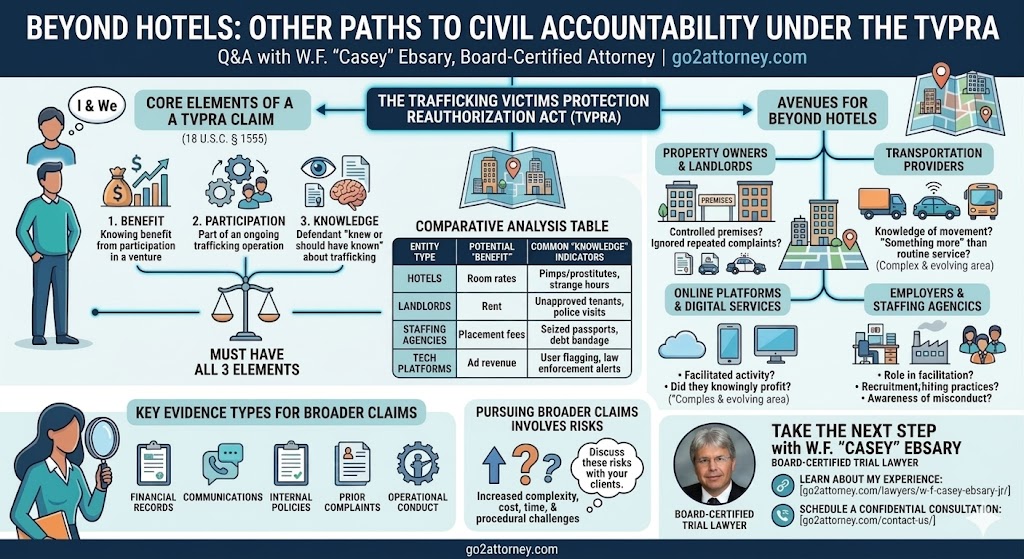
A civil claim under the TVPRA generally requires proof that a defendant knowingly benefited from participation in a venture engaged in trafficking activity. The statute, found at 18 U.S.C. § 1595, provides victims with a private right of action.
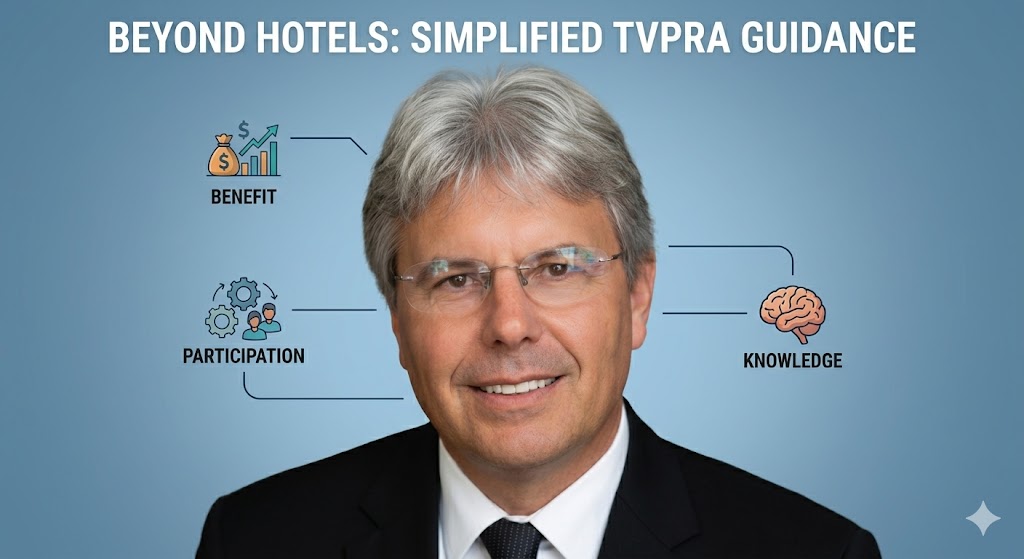
From my perspective, every case turns on three essential elements: benefit, participation, and knowledge. These are not abstract concepts—they must be supported by real, admissible evidence. Courts typically define a “venture” as an association of individuals or entities working together, whether formally or informally.
To succeed, we must show that the defendant either knew or should have known that the venture was engaged in trafficking. If any one of these elements is missing, the claim may not survive. I approach these elements methodically because federal courts expect precision, not speculation.
Beyond hotels, what other entities may be examined in a TVPRA claim?
Although hotels are frequently discussed, they are only one piece of a much larger picture. Depending on the facts, other entities may include transportation providers, landlords, staffing agencies, and online platforms.
The TVPRA is intentionally broad, but it is not limitless. The central question is always the same: did the entity knowingly benefit from participation in a trafficking venture? That inquiry requires a deep examination of operations, policies, and what employees or agents observed.
Every case is different. A labor trafficking case involving agricultural workers may look very different from a sex trafficking case involving hotels. I focus on evidence—not assumptions—when identifying potential defendants.
Can landlords or property owners be held accountable?
Yes, in certain circumstances. When trafficking occurs on property controlled by a landlord, I examine whether the owner had actual or constructive knowledge and whether their conduct could be viewed as participation in a venture.
This often involves looking for patterns—repeated police visits, persistent complaints, or obvious signs of illegal activity. In some cases, the issue becomes whether the landlord engaged in “willful blindness,” choosing to ignore clear warning signs to continue receiving financial benefits.
However, I do not assume liability simply because criminal activity occurred on a property. The law requires a direct connection between the landlord’s conduct and the trafficking venture. If that connection is not supported by evidence, I will not pursue the claim.
What about transportation providers?
Transportation can play a role in trafficking operations, particularly when victims are moved between locations. In some cases, I evaluate whether a transportation provider’s conduct goes beyond routine service.
This is a challenging area. Providing transportation alone is generally not enough. I must identify “something more” that links the conduct to participation in a trafficking venture. That could include repeated conduct, facilitation, or ignoring clear warning signs.
Courts are cautious in this area, especially with common carriers. If I cannot establish knowledge and participation with credible evidence, I will not move forward.
Can online platforms or digital services be involved?
This is one of the most complex and evolving areas of law. In some cases, online platforms may be examined if they are alleged to have facilitated trafficking activity.
However, I am careful not to overstate what the law allows. There are significant legal defenses and statutory protections that may apply. Any claim involving a digital platform requires detailed legal and technical analysis.
If I am not confident that a claim is viable under current law, I will say so. I do not pursue speculative or untested claims without a solid legal foundation.
Can employers or staffing agencies be liable?
In labor trafficking cases, I may evaluate whether employers or staffing agencies contributed to exploitation. This can include examining recruitment practices, wage arrangements, and working conditions.
For example, evidence of coercion, debt arrangements, or document control may be relevant. However, I do not assume liability based solely on an employment relationship. The same three elements—benefit, participation, and knowledge—must be established.
If those elements are not supported by evidence, I will not pursue a claim.
Comparative Analysis of Potential Defendants
| Entity Type | Potential Benefit | Common Indicators of Knowledge |
|---|---|---|
| Hotels | Room revenue, fees | Repeated complaints, unusual traffic patterns |
| Landlords | Rent payments | Police activity, tenant reports |
| Staffing Agencies | Placement fees | Reports of coercion or unsafe conditions |
| Digital Platforms | Advertising revenue | Repeated flagged content or reports |
This table is not a checklist. It is a framework I use to evaluate whether the facts support further investigation.
What types of evidence are important when expanding beyond hotels?
When evaluating additional defendants, I focus on evidence that ties the entity directly to the core elements of a TVPRA claim.
Evidence Considerations
| Evidence Type | Why It Matters |
|---|---|
| Financial records | May show benefit from the activity |
| Communications | Can indicate knowledge or awareness |
| Internal policies | May reveal failure to address risks |
| Prior complaints | Show repeated warning signs |
| Operational conduct | May demonstrate participation |
I do not rely on isolated facts. I evaluate whether the totality of the evidence supports a legally viable claim.
How do I determine whether to include multiple defendants?
Including multiple defendants can increase both the complexity and cost of litigation. I do not add parties without a clear legal basis.
My approach is to evaluate each potential defendant individually. If the evidence supports the required elements and can withstand legal scrutiny, I consider including that party. If not, I do not.
This disciplined approach helps maintain credibility and strengthens the overall case.
Are there risks in pursuing broader claims?
Yes. Expanding a case can increase costs, delay resolution, and introduce additional legal challenges. Defendants may also shift blame among themselves, complicating the case further.
I discuss these risks openly with my clients. My goal is not to pursue the largest case possible, but the strongest one supported by evidence.
Can state law claims still apply alongside TVPRA claims?
Yes. In addition to federal claims, state law claims such as negligence or premises liability may apply.
However, I do not assume these claims are always available or beneficial. State laws vary, and some may impose shorter deadlines or different standards. Each case requires a careful evaluation of applicable law.
How do courts evaluate “knowledge” across different industries?
Constructive knowledge—what a defendant should have known—is evaluated based on the specific context. What counts as a “red flag” in one industry may not apply in another.
Courts often look at whether the defendant ignored obvious warning signs. However, those signs vary depending on the nature of the business. I tailor each case to the specific industry involved.
What damages may be available?
Under federal law, victims may seek compensatory damages and, in some cases, punitive damages. Attorney’s fees may also be recoverable.
I do not promise outcomes. The availability and amount of damages depend on the evidence and how the law is applied.
Frequently Asked Questions
Can I pursue multiple defendants at once?
Yes, if the evidence supports claims against each one. I do not include parties without a solid legal basis.
What if I am unsure who was involved?
That is common. I can investigate and help identify potential defendants, but I do not make claims without evidence.
Does adding more defendants increase the value of a case?
Not necessarily. The strength of the evidence matters more than the number of defendants.
How do I know if my case is strong?
That requires a detailed review of the facts. I evaluate each case carefully before offering an opinion.
Take the Next Step
Learn more about my trial experience:
https://www.go2attorney.com/lawyers/w-f-casey-ebsary-jr/
Schedule a confidential consultation:
https://www.go2attorney.com/contact-us/
Final Thought
TVPRA claims extend beyond any single industry, but they are not unlimited. Every claim must be grounded in evidence and supported by law.
I do not speculate, and I do not overreach. If I do not know the answer, I will say so. What I offer is a disciplined, evidence-based approach to identifying and pursuing accountability where the law supports it.
W.F. “Casey” Ebsary Jr.
Board-Certified Criminal Trial Lawyer
go2attorney.com
- Video: New Lawsuit Filed Following Clearwater Ferry Collision
- Extreme Speed, Street Racing, and Civil Liability: Landmark Lessons from the $176M Grossman and Erickson Verdict
- Toll Fraud Scam Consumer Warning:
- E-Bike Accident Lawyer Tampa | Hit by an E-Bike in Florida? Know Your Rights
- TVPRA Claims – Trafficking Victims Protection Reauthorization Act